





The country’s major parties all back the new 30-year plan. ICE Policy Fellow Richard Threlfall explains why this matters.

In February, the New Zealand Infrastructure Commission, Te Waihanga, published its ambitious 30-year National Infrastructure Plan.
The New Zealand government has now responded to the plan, supporting, or supporting in principle, every one of the commission’s 16 recommendations.
The response is remarkable in representing the support of not just the current government, led by the National Party, but also the Labour Party and Green Party.
It’s dramatic progress towards cross-party consensus on infrastructure policy from a country which, until recently, was one of the most politically divided on the subject.
What needed to change?
Some of New Zealand’s challenges are unique, while others are frightfully familiar.
The country has spent around 5.8% of GDP on infrastructure each year over the last two decades, making it one of the highest spending countries in the Organisation for Economic Co-operation and Development (OECD).
But it ranks near the bottom of the pack for efficiency or ‘bang for buck’.
A small population spread across a long and narrow collection of islands has contributed to this inefficiency.
But a slow and expensive planning system, paired with a focus on ‘new and shiny’ capital projects over maintenance and renewal projects, has worsened the picture.
The 30-year plan tries to address some of these challenges.
The ICE-convened Enabling Better Infrastructure (EBI) programme has helped the New Zealand Infrastructure Commission develop the plan over the last few years. Here we unpack what’s in the plan, and what the government has committed to in response.
What’s in the 30-year plan?
The plan sets out a series of recommendations for government under four main themes:
- Planning what we can afford
- Looking after what we’ve got
- Prioritising the right projects
- Making it easier to build better
These include recommendations like:
- Reforming funding and oversight of the land transport system. New Zealand’s transport funding system has long been overstretched. Changes already underway include the expansion of user charges.
- Ensuring capital allowances and workforce plans respond to long-term infrastructure needs and asset management plans.
- Introducing longer-term and more predictable funding cycles for government. Like the UK, New Zealand has historically funded infrastructure on annual or shorter-term cycles. The funding system for economic infrastructure is increasingly longer term, and the government is now looking at extending this approach for social and defence infrastructure as well.
- Bringing together assurance (review and approval) systems to assess performance across the whole infrastructure system.
- Committing to a stable and well-coordinated resource management framework. The country’s resource management system is in the middle of considerable reform, with parliament set to pass legislation supporting a renewed planning and consenting system ahead of the general election in November.
- Clarifying and coordinating electricity investment.
- Strengthening public sector project leadership.
Demographic changes will make future investment more difficult
The commission has also highlighted a particular challenge that other advanced economies will soon experience.
Infrastructure programmes have traditionally been designed on the assumption of an increasing population. Governments generally prioritise new economic infrastructure (transport, energy, digital, etc) to drive growth.
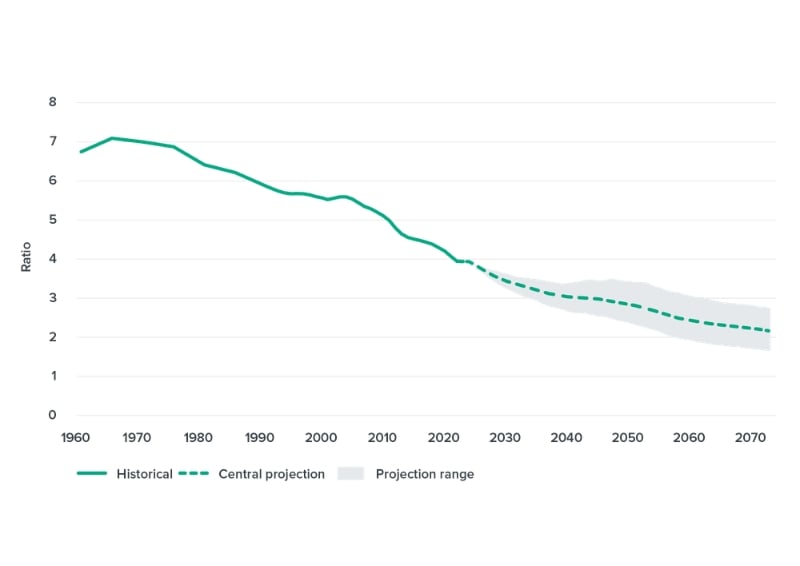
In New Zealand, a falling and ageing population will make it harder to pay for infrastructure, as healthcare and benefits costs rise and taxes from working-age people fall.
The commission has estimated that 60% of new investment will need to go towards maintaining and renewing existing assets. And investment in social infrastructure (such as healthcare facilities), will become much more important than, say, investment in new roads.
Targeting investment for the biggest impact
As well as system-level actions, the commission has used its forward guidance – a method for forecasting infrastructure demand over time – to identify 10 areas that require more immediate attention.
![Sector-level capital investment demand and key drivers. Source: National Infrastructure Plan. New Zealand Infrastructure Commission (2026) [<a href="https://www.ice.org.uk/media/1vfhnnsw/sector-level-capital-investment-demand-and-key-drivers-nz-nip.jpg" target="_blank">click to enlarge image</a>]](/media/1vfhnnsw/sector-level-capital-investment-demand-and-key-drivers-nz-nip.jpg)
The plan also draws on the latest assessments from the Infrastructure Priorities Programme (IPP), giving decision-makers a vetted menu of priority projects.
And it brings together data on $275 billion of projects currently in planning and delivery across New Zealand, helping to ensure decisions aren’t made in isolation.
What has the New Zealand government committed to?
The government has supported all 16 of the commission’s recommendations, albeit three of them only “in principle”. This means the government accepts the general thrust of the recommendation but not the commission’s proposed approach to realise it.
Two of the recommendations the government supports in principle relate to government budgeting: one ensuring funding is predictable, the other that it’s long-term. The third relates to workforce planning.
Both are critical areas in need of reform and I look forward to seeing the government’s proposals, which it’s committed to bringing forward within the next year.
Finally, it was surprising to see the government’s response make no mention of Māori involvement in the plan.
Te Waihanga worked closely with Māori throughout the plan’s development. The commission also recommended the government strengthen relationships with Māori to improve infrastructure system outcomes.
Strategic infrastructure planning is most effective when governments understand and address everyone’s needs, including those of indigenous communities.
The ICE’s view
The ICE is delighted to see the progress that New Zealand has made in its infrastructure governance, planning, and policy over recent years. The government’s response to the National Infrastructure Plan is another milestone.
New Zealand was increasingly politically divided on infrastructure policy, exemplified in the decision of the incoming government three years ago to scrap the previous government’s water reform programme.
However, in one stroke, the country has now leapfrogged all others in the unprecedented decision to include the support of other political parties in its response.
As Infrastructure Minister Chris Bishop said, “A plan delivered by independent experts can, and should, endure through political cycles. …Governments of all flavours should use best practice to plan, select, fund, finance, deliver, and look after infrastructure.”
The EBI team and international expert network has worked with Te Waihanga over the past two years to help develop this plan. This has included:
- Three dialogues to help identify New Zealand’s long-term needs and shape its pipeline of projects.
- A podcast with Professor Jim Hall, ICE Past President and chair of the EBI steering group.
- Two events to share key insights on building consensus and avoiding costly mistakes.
The team also participated as international experts on Te Waihanga’s quality review panel for the plan, supported by a group of global infrastructure leaders.
As part of this, they visited New Zealand in June 2025 for a packed week of activities including:
- A roundtable about the roles and responsibilities of infrastructure commissions worldwide.
- A podcast with Te Waihanga chief executive Geoff Cooper about international examples of efficient and effective infrastructure planning.
- A presentation at the Te Waihanga Infrastructure Leaders Network in Wellington about the importance of trust-building in infrastructure projects.
- A meeting with Māori infrastructure experts to better understand the infrastructure needs, perspectives, priorities, and aspirations of Māori.
- A visit to Christchurch to learn about post-disaster governance.
Infrastructure is the foundation of the long-term future of a country. The New Zealand government has now transcended party politics to cement that approach.
The ICE is pleased to have played its part in helping New Zealand get to where it is today.
*The ICE welcomes guests to share their views about infrastructure policy issues on the Infrastructure Blog. These views are the views of the individual.
If you're interested in writing for the Infrastructure Blog, please email [email protected]. The ICE reserves the right not to publish articles that have been submitted.

You may also be interested in

- Type
- Infrastructure blog
New Zealand is short of thousands of engineers - here's how it's closing the gap
Workforce planning amid a changing political climate is difficult, but engineers love a challenge, writes Richard Templer.

- Type
- Infrastructure blog
Built to last: the infrastructure planning toolkit that outlives politics
The updated version of the Enabling Better Infrastructure (EBI) guidance can help governments make decisions that will benefit communities in the long term.

- Type
- Infrastructure blog
How can governments ensure their infrastructure plans support indigenous communities?
Peru, Canada, and New Zealand consult with indigenous people to ensure their needs are included in infrastructure plans.