





ICE Knowledge Hub
Access the very latest and best CPD content to help you grow your knowledge and skills.
Sign in now

Dr Mike Rustell, founder and CEO of Inframatic, explores what remains irreducibly human in AI-assisted design.

A geotechnical engineer reviews an AI-generated retaining wall design.
The calculations are correct. The code checks pass. The specifications are met.
But she looks at the site photos and says: "I don't like this ground".
Nothing in the numbers tells her that.
It's decades of experience with London Clay. It's a memory of a similar site where a service trench nobody documented had altered the drainage.
It's an instinct – built from hundreds of projects – that something here does not add up.
She asks for additional boreholes. They reveal a perched water table that the original investigation missed entirely.
That instinct is engineering judgement. And as AI systems grow more capable, understanding what judgement actually is, and where it remains essential, has never been more important.
Engineering judgement isn't calculation. It's not code compliance.
It's how we integrate incomplete information under uncertainty to reach decisions that are defensible, proportionate, and appropriate to context.
Consider what this involves in practice.
An engineer choosing between two technically compliant foundation options isn't simply comparing numbers.
She is:
Judgement also includes knowing when to stop analysing and start deciding, knowing when additional investigation is needed, and, critically, knowing what you do not know.
These are capabilities that depend on experience, context, and a form of professional intuition that is difficult to formalise.
None of this means AI has no role. Quite the opposite.
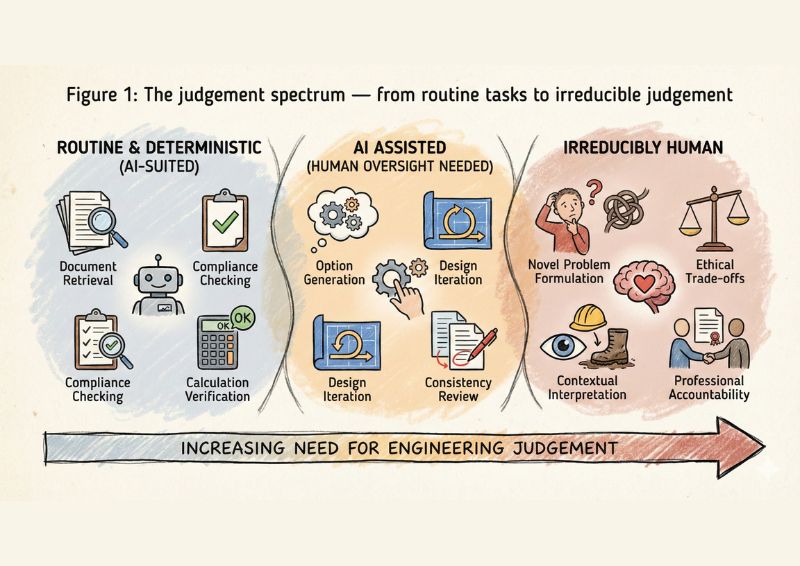
AI is exceptionally good at the tasks that consume engineers' capacity without requiring judgement – and freeing that capacity is enormously valuable.
Consider a typical design workflow.
An engineer might spend hours searching through historical reports for relevant precedents, cross-referencing standards, or checking calculations for consistency.
These are important tasks, but they are information processing, not sense-making.
AI tools can handle this work faster and more comprehensively than any individual.
The result is not that judgement becomes less important, but that engineers have more headspace to exercise it.
The key insight is using AI as a reasoning engine over your own verified data, not as a source of knowledge itself.
When AI retrieves, synthesises, and cross-references information so that an engineer can make a better-informed decision, both human and machine are doing what they do best.
This is where clarity matters most.
There are categories of engineering activity where AI cannot stand in for human judgement. Not because the technology is immature, but because the nature of the task demands something AI doesn't have.
AI systems perform well on problems similar to their training data.
But engineering projects often involve unusual combinations of common elements: a standard bridge in unusual ground, a familiar structure in an unfamiliar loading regime.
These are the situations where experienced engineers earn their fees, and where AI is most likely to produce outputs that look plausible but miss something critical.
AI is increasingly capable of solving problems that are clearly defined.
But in engineering, defining the problem correctly is often the hardest and most meaningful step.
It requires an understanding of the project's context, the client's risk appetite, and the consequences of getting things wrong.
AI can generate options. It can't decide what the real question is.
Engineering decisions often involve balancing competing interests: cost against safety margin, environmental impact against client budget, and so on.
These are human decisions about what matters, and they carry professional and sometimes personal accountability.
AI has no values. It can't weigh what matters, only what can be quantified.
Experienced engineers bring a web of implicit knowledge to every decision:
AI can process explicit information with extraordinary speed.
But it lacks the contextual understanding that comes from years of walking sites, reviewing failures, and learning – sometimes painfully – what the textbooks leave out.
If AI handles the tasks through which engineers traditionally developed judgement, how will the next generation learn?
Engineers learn judgement by doing the routine work – checking calculations, reviewing drawings, writing specifications – under the supervision of experienced practitioners who explain not just what to do, but why.
It's how engineers internalise standards, develop intuition for what ‘looks right’, and build the pattern recognition that underpins professional confidence.
If AI absorbs this layer of work, we risk losing the link between practice and competence.
This points to an important difference between ‘doing the work’ and ‘understanding the work’.
The goal isn't to preserve drudgery for its own sake. It's to ensure that engineers who review AI-generated outputs can genuinely evaluate them.
Not just confirm that the numbers fall within expected ranges, but understand the assumptions behind them, recognise when something is missing, and know when to push back.
An engineer who has never manually checked a retaining wall design will struggle to spot the subtle error in an AI-generated one. Understanding requires having done the work at some point, even if you no longer do it daily.
Civil engineering faces a design challenge of its own: building AI-assisted workflows that preserve the learning journey, not just the output.
This might mean structuring early-career work so that graduates still perform manual checks before seeing the AI’s answer. Or, designing review processes where junior engineers must explain why an AI output is correct, not just confirm that it is.
The goal isn't to slow AI use, but to ensure that the profession continues to produce engineers capable of exercising the judgement that AI can't replace.
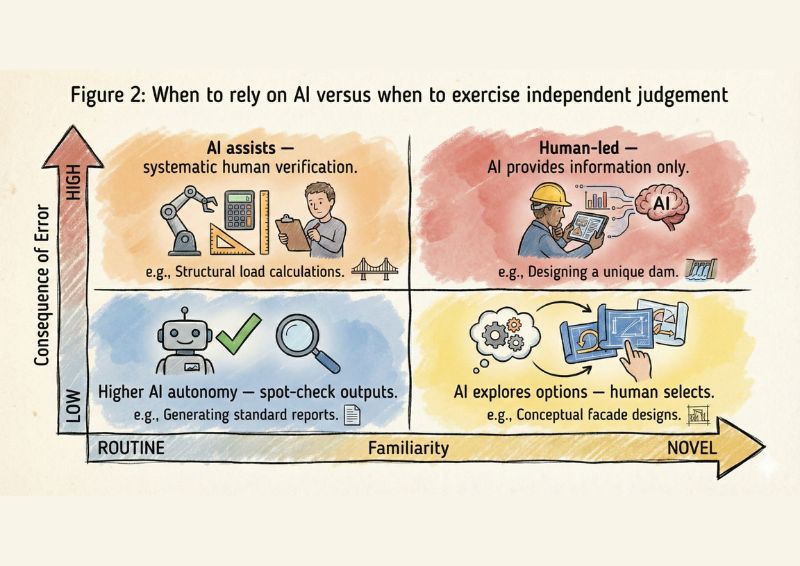
As an industry, we are still finding our feet with generative AI.
But the engineers and institutions that think clearly about where judgement lives – and invest in developing it – will be the ones who use AI most effectively.
The technology handles information. The judgement remains ours.

Candidates who meet the requirements are invited to stand to represent the institution as a future president of the ICE.

The Infrastructure Client Group's 2026 benchmarking survey shows progress, but greater focus is needed on value, data quality and delivery outcome.

ICE President David Porter explains why being informed about flood risk is so important for the public and civil and infrastructure engineers.
