





A new ICE report calls for a review into the value of infrastructure adaptation and climate resilience in order to boost investment.

The UK just had its hottest ever summer, with many regions experiencing droughts and wildfires.
June’s heatwave is estimated to have led to 24 million lost working hours and a £1.15 billion hit to the UK economy.
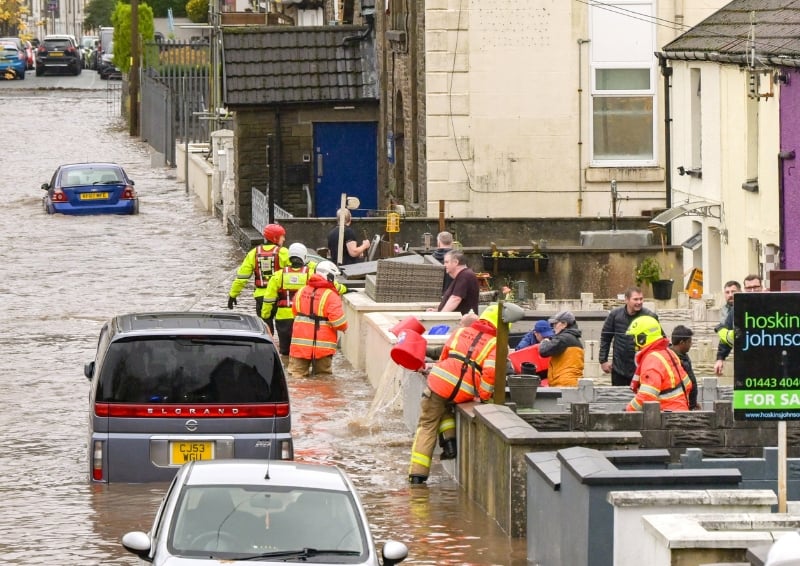
Extreme weather events are becoming more commonplace and are expected to worsen in the decades ahead – but the UK’s infrastructure isn't ready for them.
The Labour government has signalled it will strengthen climate resilience efforts. Intent must now turn into delivery.
Why isn’t the government investing more in resilience?
Infrastructure systems present a huge opportunity to create a more climate-resilient future.
The services resilient infrastructure enables create economy-wide benefits. They reduce disruption to communities, businesses and public services from climate-related shocks, while supporting productivity, investment and long-term economic growth.
Yet, infrastructure resilience and adaptation are consistently undervalued in investment decisions.
As a result, more and more assets are failing or at risk of doing so.
The costs of maintaining, adapting and reconstructing those assets will only rise with climate change – acting early will cost less.
But government departments and asset owners need the evidence to make the case for appropriate funding.
The ICE’s new policy paper makes the following recommendations for achieving that:
1. Commission a review of the economic value of climate adaptation and resilience
A more complete understanding of the benefits, as well as the costs, of adaptation and resilience would encourage the required levels of investment.
The 2006 Stern review on the economics of climate change had a huge impact in stirring public and private action towards net zero.
Climate adaptation and resilience need a similar approach.
The ICE is calling for a review owned by a senior minister in central government – such as the Office for the Prime Minister and Cabinet – supported by relevant departments like HM Treasury and the Department for Environment, Food and Rural Affairs (Defra).
The review should build in independent challenge. For example, through an expert advisory group.
This would ensure it focuses on outcomes for people, nature and the economy and gathers insights from a wide range of stakeholders, experts and international best practice.
2. Take a whole-system approach
Infrastructure is a system of systems. Understanding the interdependencies and potential for cascading risks across different sectors will strengthen the economic case for adaptation and resilience.
The review should also consider the UK’s resilience governance framework, which the Climate Change Committee (CCC) says is ‘not fit for purpose’.
Current resilience and adaptation policies, standards, regulation and guidance are anything but joined up across government.
This lack of systems thinking is particularly problematic for a domain that is intrinsically systemic.
The review should consider what must happen to strengthen alignment and reduce friction to deliver adaptation projects across all sectors and levels of government.
3. Close data gaps
Better understanding the economic value of adaptation and resilience depends on the quality and availability of relevant data.
The review should map who owns relevant datasets, how accessible they are and what would be required to make them useful for resilience planning.
While a lot of data already exists, much of it is fragmented across multiple bodies.
There are also significant gaps, including the impacts of current weather events on infrastructure assets and services, and understanding interdependencies and cascading risks.
The benefits of more data need to be balanced against the costs of collecting and curating it. Decisionmakers also need the skills and tools to apply it effectively.
Advances in areas like real-time monitoring, AI and machine-learning could help, but need to be fully understood and harnessed.
4. Develop innovative valuation methods
Many tools and methodologies have been developed by the CCC and others to value adaptation investments, assess the cost of inaction and manage uncertainty and complex scenarios.
There’s no need to reinvent the wheel.
But new approaches are needed to understand what happens when climate risks overlap and affect multiple infrastructure assets and systems at once, making the overall impact worse.
The review should capture ‘economic value’ broadly, taking full account of the effects of climate change, adaptation measures and infrastructure performance on people, places and nature.
It could also consider the methodologies that infrastructure organisations can use to make decisions about resilience investment.
This could help develop a more consistent approach to assessing value within regulated sectors and in turn support cross-sectoral analysis.
5. Evaluate the role of regulators
The weaknesses in the UK’s resilience framework mean that key parts of government, such as regulators, struggle to prioritise climate adaptation.
One consequence may be a bias towards keeping current costs and household bills low rather enabling long-term investment in maintaining and upgrading infrastructure assets.
Navigating those trade-offs – and making the case to the public for investment – requires a better understanding of the value it will create.
Regulators also have a key role in enabling coordination between sectors to manage interdependencies and cascading risks.
The review should evaluate what role regulators do and should play in embedding climate adaptation into infrastructure investment decisions.
There’s no time to delay
The impacts of climate change on people, places, the economy and nature are becoming ever more apparent.
The summer of 2026 has shown that the UK cannot afford to delay taking the necessary action.
Amid public spending constraints and competing demands for investment, gaining a fuller understanding of the value of adaptation and resilience is a vital step the government should take.
This would help make the case for investment in areas that will deliver maximum benefits and at the best value for taxpayers.

Sustainable Development Goals:
You may also be interested in

- Type
- Infrastructure blog
Rewiring the State: what does England’s devolution mean for infrastructure?
These reforms would change where decisions are made, who holds influence, and how infrastructure and other investment priorities are determined.

- Type
- Infrastructure blog
CCC report shows it’s time to supercharge the UK’s electrification ambitions
The UK must speed up the electrification of transport, homes, and industry to reap the benefits of reducing emissions.

- Type
- Infrastructure blog
Mike Reader MP: the UK's Seventh Carbon Budget is an anti-poverty measure
The transition to net zero will lower costs, create jobs, and drive growth, writes the chair of the All-Party Parliamentary Group on Infrastructure.