





Why does the word ‘sustainability’ still cause so many people to disengage? Hannah Gold reflects on the practical takeaways from a recent ICE event.

How do we better communicate sustainability? It's a question I've often wrestled with.
Why does the word ‘sustainability’ still cause so many people to disengage? Why is it still too often seen as an add-on given what's at stake?
Leading this year's ICE Sustainability Course, I was delighted to hear perspectives from a range of experts on topics spanning carbon, materials, nature-based solutions and social value.
It was refreshing to hear genuine enthusiasm and be presented with such a range of practical solutions – you could see the world that engineers could build.
Yet it isn’t yet the world we see.
Engineers understand sustainability, but how well do they communicate it?
This sentiment was shared by participants on the course, who were asked, "How well do you think the industry currently considers sustainability?" The average response was just 2.9/5.
One question kept resurfacing: How do we convince clients this is the right way?
When we have so many solutions, tools and roadmaps at our disposal, why does widespread adoption still feel so slow?
Perhaps the next challenge for our industry is not understanding sustainability but learning how to communicate its value more effectively.
Following the course, we hosted a workshop exploring this theme. We were joined by Antony Oliver, host of The Infrastructure Podcast, and Alex Lynes, associate director at Webb Yates, who shared practical insights on how to communicate more effectively.
If sustainability is the destination, how do we get there?
Sustainability may be the destination, but people are motivated by different priorities.
To bring others with us, we need to better understand what matters most to them. That requires active listening and empathy.
As Antony says: “For the engineering profession, communicating sustainability is hard. It means so many different things to so many different people.
“Frankly, in a world typically driven by black and white design choices, it presents engineers with a very tricky, and often uncomfortable set of ideas to pin down and measure effectively.”
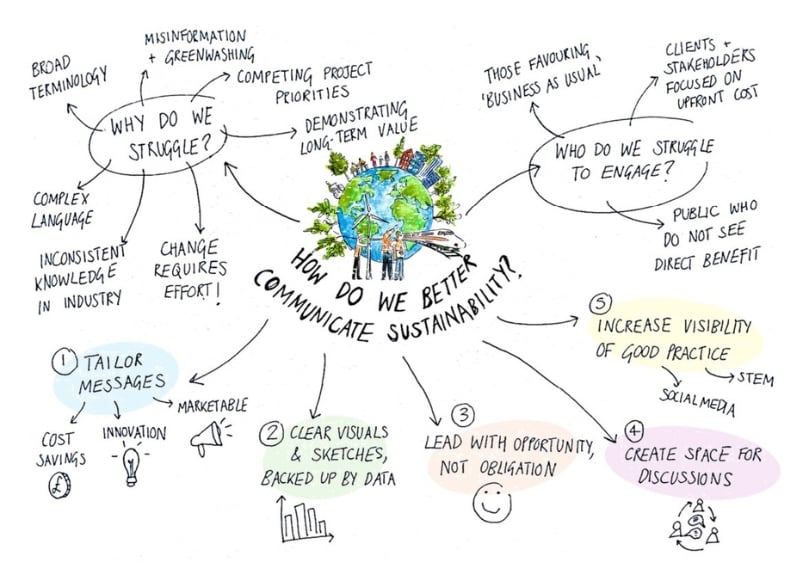
7 reasons why engineers struggle to communicate about sustainability
1. Broad and often misunderstood terminology
At its core, sustainability is about meeting today's needs without compromising the ability of future generations to meet theirs.
However, it’s often used as an umbrella term to describe a wide range of issues, which can make conversations unclear.
2. Widespread misinformation and greenwashing
Sustainability discussions are often clouded by conflicting information, oversimplified claims and, in some cases, deliberate greenwashing.
This can make it difficult for people to distinguish genuine impact.
3. Complex language and technical concepts
Technical terms and industry jargon can make sustainability difficult to engage with.
While concepts such as whole-life carbon and embodied carbon are important, they can be inaccessible to non-specialists.
4. Competing project priorities
Cost, programme, risk and performance objectives often dominate decision-making.
As a result, sustainability can be perceived as an additional consideration rather than an integral part of delivering successful projects.
5. The challenge of demonstrating long-term value
Some sustainability benefits are realised over decades rather than immediately.
Quantifying and communicating these long-term environmental, social and economic benefits in a compelling way can therefore be difficult.
6. Change requires effort
Sustainability often involves challenging established practices and adopting new approaches.
When the benefits are not immediately visible, there can be a natural tendency to default to familiar ways of working.
7. Inconsistent knowledge across the industry
Sustainability has not historically been embedded within all engineering education and training pathways.
How do we do better?
Tailor the message to your audience
Focus on the benefits that matter most to them, whether that’s cost savings, innovation or commercial advantage.
Sustainability doesn’t always need to be the headline. Often it’s more effective to communicate the outcomes it enables.
Keep communication clear, simple and accessible
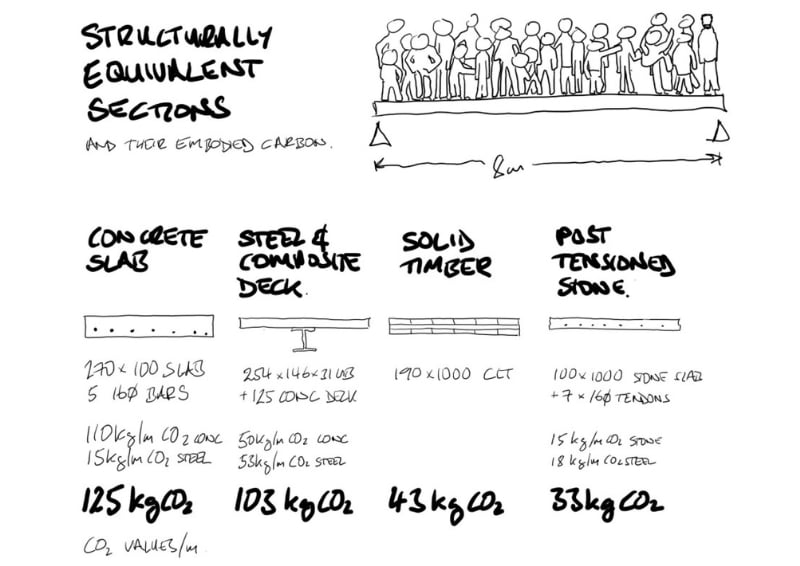
Avoid unnecessary jargon and use visuals, data and sketches to support conversations.
Real-world case studies can be particularly powerful in demonstrating what successful implementation looks like in practice.
Lead with opportunity, not obligation
Positive and engaging narratives are more likely to inspire action than messages centred on restriction or sacrifice.
Sustainable solutions should be presented as a way to create value, improve outcomes and drive innovation.
Create space for open discussion within our organisations.
Building confidence and understanding internally is an important first step.
We need to be comfortable discussing sustainability among ourselves before we can communicate it effectively to others.
Increase the visibility of good practice
By sharing successful projects through social media, education and industry engagement, we can help build wider awareness of what sustainable engineering looks like and the benefits it can deliver.
"For me, successful communication comes down to the basics,” says Antony. “Deciding who are you trying to talk to about sustainability and then deciding what message are you trying to get across to them. Then making it interesting, exciting and actionable.”
“There will not be a single group and so there will not be a single massage. But engineers must take the time and bold enough to make those decisions, to create the right messages that interest, excite and prompt action from the people they are trying to persuade."
One of the most important skills for engineers
Richard Bayfield, ICE Senior Vice President, emphasised that “effective communication is one of the most important skills for engineers whose work impacts the public”.
“The ECNet should be applauded for organising an event focused on communicating sustainability more effectively,” he adds.
“I particularly welcomed the discussion around using clearer, more accessible language for technical standards. Hannah and colleagues' suggestion of supplementing ‘PAS 2080’ with the phrase ‘the infrastructure decarbonisation standard’ merits wider discussion, and potentially adoption, across our learned society.”
Share your views
This is a topic we are keen to continue exploring through the ICE. If you have experiences or perspectives to contribute, we would be delighted to hear from you.

Sustainable Development Goals:
You may also be interested in

- Type
- Awards and competitions
People’s love of heritage and the place-making power of infrastructure celebrated at South West awards
The public and judges rewarded projects that enhance local places and communities while improving resilience, access and biodiversity.

- Type
- News
ICE Trustee Board election: your chance to stand
The institution is seeking new trustees to oversee two portfolios: professional conduct and ethics, and policy and external affairs.

- Type
- Infrastructure blog
What's in the UK government's plan to make transport disruption-proof?
People, capability and preparedness are central to the UK's Department for Transport's approach.