





At the latest UK Real Estate Investment and Infrastructure Forum (UKREiiF), the ICE spoke about the need to stick to the plan and get on with delivery.
Just over two years ago, leaders from across the built environment sector were glued to their phones.
Stood in the rain, miles from Westminster at the UK Real Estate Investment and Infrastructure Forum (UKREiiF), they were contemplating the outcome of a seismic election that days before hadn’t been on anyone’s radar.
In some ways, things don’t change.
But thankfully, at least when it comes to the UK’s infrastructure, we are a world away from where we were in 2024.
While a lot of the coverage was caught up with what was happening with the Makerfield by-election and in Westminster, the focus on the ground was about how we get on and deliver the government’s ambitious plans.
What is UKREiiFF?
Last month, the ICE’s director general, Dr Janet Young, and the policy and external affairs team were in Leeds for the fifth annual UKREiiF.
In that short time, the forum has fast become the event of the year for built environment and infrastructure professionals, local authorities and politicians from all parties.
Imagine the annual political party conferences, if they only focused on infrastructure and housing.
So, the perfect audience for us to talk about our policy positions and understand the latest thinking.
This year, over 16,000 delegates packed into the Royal Armouries site at Leeds’ Dock.
ICE on the ground: turning plans to delivery
Realising the potential of the 10-Year Infrastructure Strategy
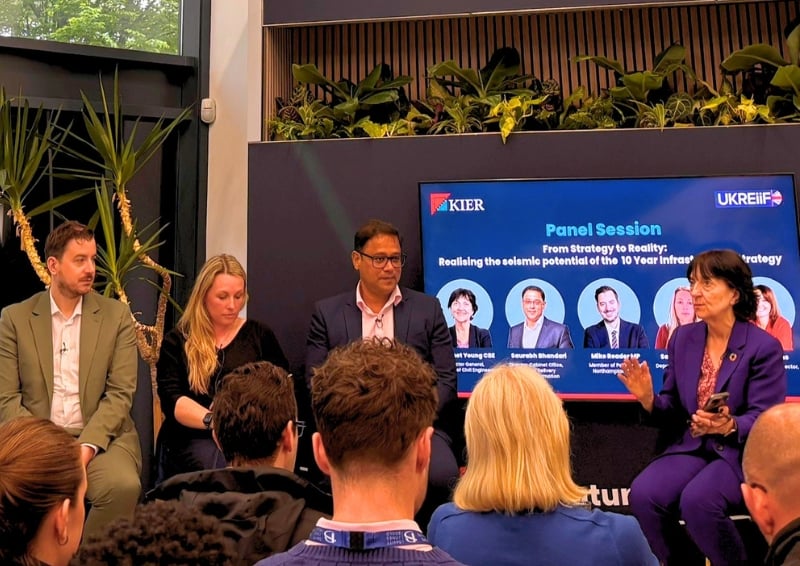
Janet joined senior civil servants Saurabh Bhandari (Cabinet Office) and Sarah-Jayne Pizzie (Ministry of Justice) along with Mike Reader MP, chair of the APPG on Infrastructure, to talk about the UK’s infrastructure strategy.
One of the biggest changes since 2024, or even last year's conference, is that we now have a 10-year strategy and an accompanying pipeline of projects.
Part of the focus of the discussion was that, for the first time, this strategy has brought together social and economic infrastructure in one place.
Panellists agreed that social infrastructure is finally gaining strategic clarity, with departments collaborating more and experimenting with innovative finance and delivery models.
There’s a huge amount that can be learned and built upon across all of infrastructure.
But the big challenge ahead is taking promising pilots and rolling them out quickly, on a much larger scale, while making sure all the various parts of government work together to achieve the same aims.
Removing barriers to delivery
The ICE partnered with AECOM to host a roundtable with infrastructure leaders on how to reduce barriers to infrastructure delivery.
Built on reports by AECOM and the ICE, the lively discussion covered:
- The critical decisions the government needs to make to unblock major infrastructure projects; and
- The need for the industry to ensure it has the people, skills, systems, and resources to deliver, and to attract investment.
One of the key messages that emerged was the need for national and regional governments to better explain what the new investment in infrastructure actually means for the public. In particular, what benefits will they see.
Intentions vs experience
The event was timely as the ICE has just published a report exploring the gap between how infrastructure is intended to serve people and how it is experienced in practice.
It includes ICE-commissioned polling that found that 78% of Brits don’t feel that people like them are listened to when infrastructure is planned, funded and delivered.
Finally, alongside various meetings with senior stakeholders from across the sector, we also attended a roundtable on the circular economy hosted by Skanska and another on the skills gap.
A takeaway for the train home
There’s no doubt that the conference was at the centre of the political storm (along with some literal ones).
While the political winds could bring change, there was one message that was clear throughout.
We have the right strategies. The tools and levers are in place.
What’s needed now is the certainty that the government will stick to the plan and not go back to the days of stop-start interventions.
If it can commit to that, it’s then down to the industry to show it has the ability to deliver.

You may also be interested in

- Type
- Infrastructure blog
Why the CMA's civil engineering market study is a once-in-a-generation opportunity
It will take more than a strategy paper to change the fortunes of the sector. Mike Reader MP explains why the Competition and Markets Authority's recent study could lead to real change.

- Type
- Infrastructure blog
What architecture is getting right about inclusive design
The Royal Institute of British Architects' (RIBA) has shared best practice that the infrastructure sector can apply in its work.

- Type
- Infrastructure blog
How do you build infrastructure with communities, not just for them?
A new ICE policy programme will explore public engagement in infrastructure in the hopes of speeding up delivery and rebuilding public trust.