





For World Engineering Day for Sustainable Development, infrastructure engineers share their predictions for the sector while considering what it will take to succeed.
When pop-punk band Busted said we’d live underwater in the year 3,000, they didn't specify what caused the move. Could they have been thinking about rising sea levels, or increasing flood risk?
Regardless of what inspired the original lyric, any future-gazing we do now must consider the ways our climate is changing. And if we’re going to build a world we can sustainably live in for the next millennium, we’re going to need more than a flux capacitor.
We asked some of our infrastructure engineers where they think the industry is headed, and the skills we'll need to get there.
Humans and nature living in harmony
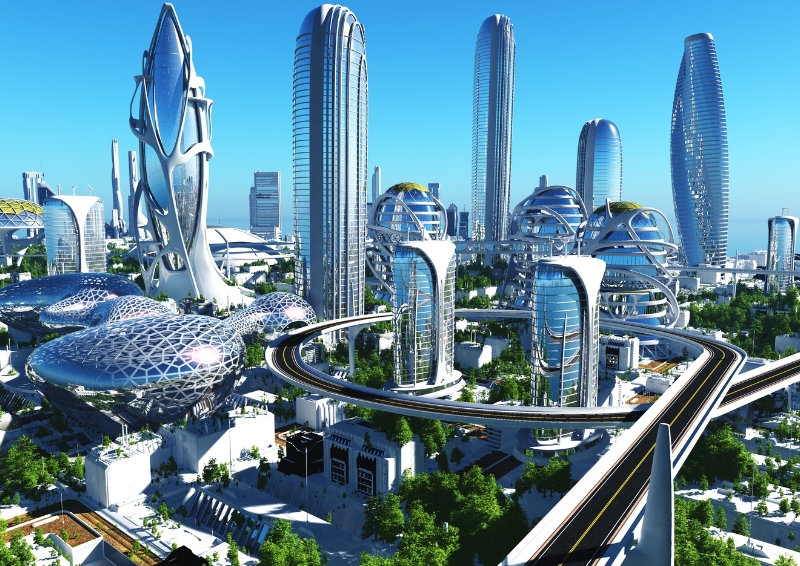
Images of future cities tend to be very high-tech, hinting towards further automation and maybe even the rise of flying cars.
But for Conor McDevitt, senior project manager at construction company Turner & Townsend, it’s more about seeing humans and nature living in harmony.
“I envisage walkable cities and open green spaces interconnected with efficient transport links such as monorail or subway systems,’ he says.
To get there, he foresees growth across the utility sector, as we’ll need water and energy infrastructure to grow and develop.
“It is vital that we do not waste our natural resources,” he says, considering the demands of new technology, such as data centres, which require a lot of water for cooling.
We’re already on the way there
The shift towards this future has already started, notes Chris Landsburgh, decarbonisation director at AECOM, the professional services firm.
“Climate risk is now a core design constraint,” he says.
Reducing carbon emissions, bolstering climate resilience and supporting nature are no longer mere add-ons to a project. They’re becoming measurable requirements.
But commercial awareness is “essential”, too, Chris points out. After all, these requirements only count it they survive the realities of delivering a construction project. Budgets, timelines, contracts – it all has to work together.
Becoming standard practice
The ICE has helped to develop standards to enable the industry to improve its decarbonisation, resilience and productivity. Find out more about them:
Digital transformation and the age of AI
For Benson Hung, lecturer at Hong Kong’s Vocational Training Council and RMIT University, smart solutions will help enable the climate resilience we need.
To achieve that, engineers will need “proficiency in analysing data for predictive maintenance and performance optimisation”.
That will mean becoming familiar with technologies such as building information modelling (BIM), the Internet of Things (IoT) and artificial intelligence (AI).
Jananie Balapitathees, assistant project manager at engineering firm Jacobs, explains why using these digital tools makes room for innovation.
She asks: “If we’re spending so much time doing admin work, looking at Excel, going row by row trying to analyse data, are we actually engineering?”
“If we can streamline that and use AI tools, for example, then we can do much more of the creative engineering that we love and keep moving forward.”
Artificial but accountable
Chris agrees, “AI can improve speed and consistency”, but “used poorly, it can accelerate errors”, he warns.
“The future will likely reward engineers who can move fast, but only if they can still prove what they did, why they did it, and what they checked,” he says.
It’s not just about what’s new
The development of technologies – such as digital twins and augmented reality – doesn’t mean that traditional ways of working will disappear.
“Modern infrastructure is rapidly evolving, and we do need to adapt to that knowledge,” says Jananie. “But we also need to be more proactive with the knowledge we can grasp from historical engineering and how we could use that today.”
She cites the Eiffel Tower as an example, for which material economy might be the top lesson. Melted down, the tower would only fill up its base about two and a half inches deep!

“Understanding basic engineering principles and knowing the current limitations of modern technology is key,” says Conor.
He shares the example of the NEOM mega project in Saudi Arabia, which was significantly scaled back in recent years.
“The ambition is there, and the appetite for the mega projects of the future is there, but we need to allow technology to catch up,” Conor says.
Engineers need to show they can do both
For engineers today, it’s essential to understand the basics, while still being open to what’s new. ICE Professional Reviewers are already on the lookout for this.
Reviewer Sue Caccavone explains: “The industry is changing and we need to reflect that at reviews.
“We're looking for people with digital skills, those that understand how AI can work for us, not against us.
“But equally, we’re still looking for some very traditional skills, like temporary works and designers.”
It’s not just those sitting reviews that need to have the skills, but those assessing them. If you think you fit the bill, get in touch about becoming a professional reviewer.
Infrastructure as a system of systems
The world we live in is already complex, and this extends to our infrastructure.
Building, water, energy, transport, digital services (and more) are all interconnected and interdependent, creating an overarching system of systems.
Engineers need to be able to think at this systems scale across all of their projects, no matter how small, as these connections will continue to expand.
Practically, this will mean “more collaborative partnerships, more programme-led delivery and better decisions earlier in the lifecycle,” explains Chris.
Skills wise, Benson foresees that this will require engineers who can manage complex projects and interdisciplinary teams.
The future is for value-driven infrastructure
Infrastructure will always be necessary. It’s how we’re able to go about our day-to-day, do what we need to do. But what and how we build is up for debate.
Reflecting on what we may stop doing in future, Chris says: “What shrinks isn’t infrastructure. It’s anything that can’t evidence long-term value, resilience, and sustainable outcomes.”
In terms of how we prepare for this future, there’s no better time than the present.
“It’s so important that we get this right,” Conor adds. “We face an opportunity due to ageing infrastructure that also needs to support a growing population.”
“We must invest time, effort and money in the right areas, which will create jobs, drive innovation and encourage people to take up careers in infrastructure across the globe.”
The profession is evolving
The ICE’s infrastructure engineer professional qualification reflects a constantly changing industry.
It recognises that the engineers of the future will be working across multiple disciplines to create the infrastructure the world needs.
Find out more on the ICE website or attend our next webinar on 20 May.

You may also be interested in

- Type
- News
RAEng names 4 leading ICE members as Fellows
The Royal Academy of Engineering (RAEng) has announced 75 individuals who are making outstanding contributions to the profession.

- Type
- Awards and competitions
Accessibility-first railway revamp wins at the ICE London Awards 2026
Held on 30 September 2026 at the ICE headquarters, One Great George Street, the awards recognised impactful infrastructure projects across the city.

- Type
- ICE Community blog
When every consultancy looks the same, where does innovation go?
There’s no shame in making a name for yourself in a consolidated industry, writes Steven Yule, ICE country representative for the UAE.