





Marc Barlow, innovation coordinator at Curtins, shares how engineers can get ahead of the curve in this age of information.

If there’s one thing our industry is good at, it’s waiting until something goes wrong before we do anything differently.
As engineers, we’re natural problem solvers and often change the way we think to overcome challenges.
But if you ask an engineer whether they’d call themselves an ‘innovator’, they’d probably shrug their shoulders in response.
The truth is: innovation has always been a core part of who we are.
Long before digital twins, climate dashboards or artificial intelligence, engineers relied on raw ingenuity, technical skill and gut feeling.
Those moments of being forced to think on our feet drove innovation long before we ever gave it a name.
Credit where credit's due
Do you know of a person or project deserving of recognition among the wider civil engineering community?
Why not nominate them for any of the 2026 ICE Awards? The nominations deadline has been extended to 11.59pm on Thursday 8 October 2026.
Innovation has emerged from need, not desire
Throughout history, innovation has often emerged from need rather than desire.
And it’s normally in the bleakest of moments, on cold, wet sites where something didn’t align, connect or perform the way it was meant to, that we engineered our way around the problem.
Take the Royal Albert Dock in Liverpool as an example. Now a major tourist attraction and the backdrop to decades of school holidays (mine included), it’s a true cultural landmark.
But before its revival, it was near derelict, widely written off and edging towards demolition.
How uncertainty saved the Royal Albert Dock
What changed its course wasn’t a grand regeneration plan, but a practical response to uncertainty.
The dock had a timber piled structure that hand calculations – the trusted method at the time – could not alone prove that it had enough loading capacity.
So, our founder Bill Curtin and his trusted colleagues chose to load test it – going as far to pour concrete around the pile heads when they began to crack.
That decision rippled out: it supported university led research, informed industry guidance still used today and crucially, helped save the Albert Dock.
The work Bill and his engineers undertook exemplified the tenacity that remains one of the greatest strengths of engineers. But the pace and complexity of today’s challenges demand more.
Innovation thrives where industries collide
Innovation is no longer solely driven by in the moment brilliance or lone wolf heroics.
It thrives in the messy collision of disciplines and lives in the chorus of diverse perspectives that previously had never been mixed.
And it’s in the most unlikely places, unconventional partnerships and unexpected ideas that we find the greatest solutions.
What we can learn from Indiana Jones
An anecdote recently shared with me by Innovate UK Business Connect exemplifies this kind of cross-sector knowledge pull.
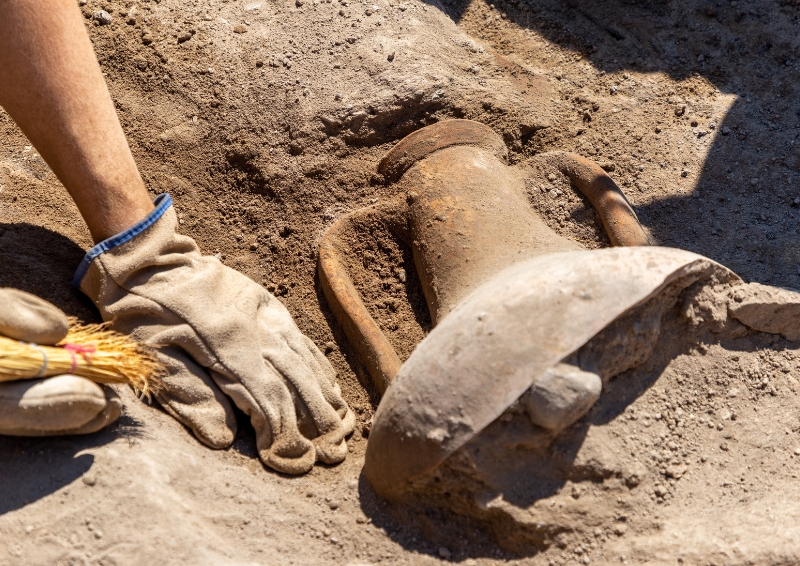
Muon tomography – the process of effectively seeing through ground without digging – is a method long used in particle physics, volcanology, and archaeology.
It has recently found success in the built environment as a non-invasive way to identify and inspect ageing underground infrastructure for ongoing asset management.
While this may be old news for some, it’s brilliant for us – not only highlighting the wealth of exchangeable knowledge sitting in distant sectors but also suggesting that maybe there’s still more to learn from Indiana Jones after all.
Embracing innovation in the modern age
If the industry had its own Eras Tour, the latest would be the information era, where data-led decisions supported by digital transformation is the direction of travel.
But are we truly ready to embrace it?
This era will push the industry to innovate faster than ever, as progress is accelerating at a pace we can’t control. For a sector that has historically lagged behind, that’s a daunting prospect.
That’s where research and development (R&D) adds real-time value.
A safe place to fail
Done properly, R&D gives businesses a safe space to explore ideas, navigate uncertainty, test options and, crucially, fail.
It prompts earlier questioning instead of last minute firefighting and builds an environment where curiosity isn’t tolerated but expected.
Innovation isn’t a silver bullet — it’s a lens that enables us to look inward at the work already being done and find better, more considered ways of delivering it.
The ICE Research and Development Enabling Fund
Have you developed an innovative idea that needs funding to get it off the ground? Are you working on a project that needs financial help to complete?
The ICE may be able to help.
Don’t save innovation for when you have time
Innovation also needs the things we’re bad at prioritising: time and trust.
Not “if the meeting finishes early” time. Not “when the project settles down” time.
Actual, deliberate, ring fenced space to encourage thinking, exploring, sketching, testing, challenging and imagining.
To get to our destination, we need leaders who are future focused, who recognise that systems-thinking is what allows us to navigate uncertainty and design resilient, interconnected solutions.
The modern engineer recognises what they know – and what they don’t
The ICE has already redefined its own expectations of what a modern engineer looks like through the professional review attributes.
“Undertaking appropriate investigation”, “contributing to continuous improvement”, “communicating new concepts/ideas” and “engaging in advancing or improved techniques and technology” are all natural principles of innovation.
But perhaps the biggest signal from the ICE is “understanding the limit of skills”.
Too often engineers feel they must know the answer immediately, as if uncertainty undermines competence – a feeling I know all too well.
When, in reality, understanding your challenge early is not a sign of failure, it’s the best possible position to start, and then innovate, from.
It gives you space to find the right partners, the right tools and the right approach, enabling problems to be solved deliberately, rather than desperately.
Where to next?
If the past taught us determination and resourcefulness, and the present teaches us collaboration and curiosity, then the future will ask something even greater of us: bravery.
The bravery to think laterally, work with unfamiliar disciplines, challenge long-standing assumptions and embrace solutions not yet imagined – before we’re forced to.
Innovation starts in blue skies, but intent takes this to value when it’s translated into blueprints. These need to be shaped by diverse voices, bold thinking, thoughtful risk and a mindset that doesn’t wait for failure to prompt change.
And when we choose to move from reaction to intention, we won’t merely adapt to the world as it is – we will help shape the next one.

You may also be interested in

- Type
- News
RAEng names 4 leading ICE members as Fellows
The Royal Academy of Engineering (RAEng) has announced 75 individuals who are making outstanding contributions to the profession.

- Type
- Awards and competitions
Accessibility-first railway revamp wins at the ICE London Awards 2026
Held on 30 September 2026 at the ICE headquarters, One Great George Street, the awards recognised impactful infrastructure projects across the city.

- Type
- ICE Community blog
When every consultancy looks the same, where does innovation go?
There’s no shame in making a name for yourself in a consolidated industry, writes Steven Yule, ICE country representative for the UAE.