





Also known as twin towns, sister cities and friendship towns, the idea is the same: build lasting relationships that strengthen international ties at a grassroots level.
Have you ever wondered if your city has a twin somewhere else in the world?
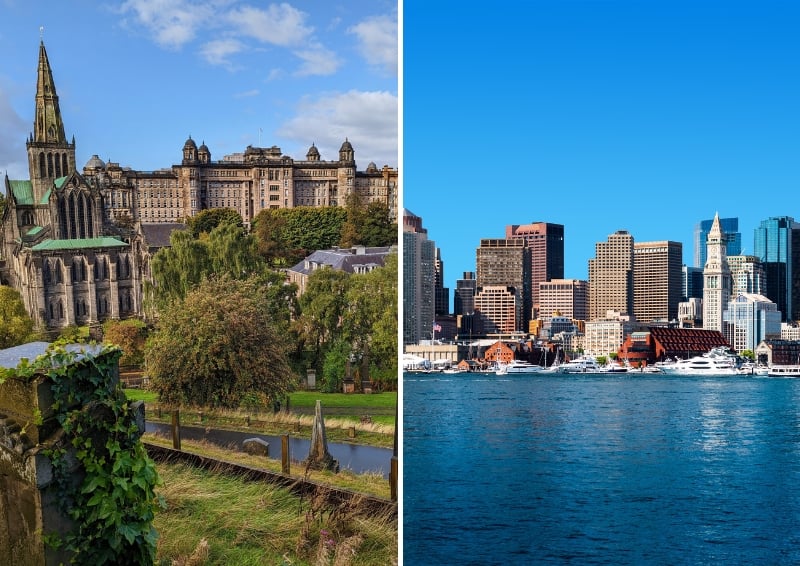
Boston and Glasgow recently became twin cities, joining thousands of partnerships that link places across the globe. While these agreements often make the news as symbolic gestures of friendship, they have become something far more practical.
Today, city twinning creates opportunities for cities to exchange knowledge, share experiences and learn from one another's approach to tackling common urban challenges.
What is city twinning?
Across the world, the language of twinning shifts depending on where you are. In the UK, you’ll most often hear ‘twin towns’ or ‘twin cities’, while in the United States the same idea is known as ‘sister cities’.
In mainland Europe the terminology becomes even more varied, with phrases like ‘partner towns’, ‘partnership towns’, and even ‘friendship towns’ all used to capture the same idea of places formally linking up across borders.
The concept emerged after World War Two, with the aim of fostering peace between communities in different countries.
The idea was simple: by building lasting relationships between ordinary people, schools and local authorities, cities could strengthen international ties at a grassroots level.
While those cultural exchanges continue today, many partnerships have evolved to support wider collaboration between local governments, universities, businesses and technical experts.
Increasingly, they're used to share ideas on everything from climate action and transport to economic development and urban planning.
Twin cities in action
There are around 2,000 twinning partnerships across the UK, and about 75% of them link British towns and cities with counterparts in France and Germany.
Globally, there are over 10,000 partnerships, connecting communities across almost every continent.
For example:
- Coventry, UK – Volgograd, Russia (1944)
- Paris, France – Rome, Italy (1956)
- Hiroshima, Japan – Honolulu, USA (1959)
- New York City, USA – Tokyo, Japan (1960)
- Berlin, Germany – Los Angeles, USA (1967)
- Sydney, Australia – San Francisco, USA (1968)
- Dublin, Ireland – San José, USA (1986)
- Beijing, China – Nairobi, Kenya (1993)
- Barcelona, Spain – Tel Aviv, Israel (1998)
- Cape Town, South Africa – Aachen, Germany (1999)
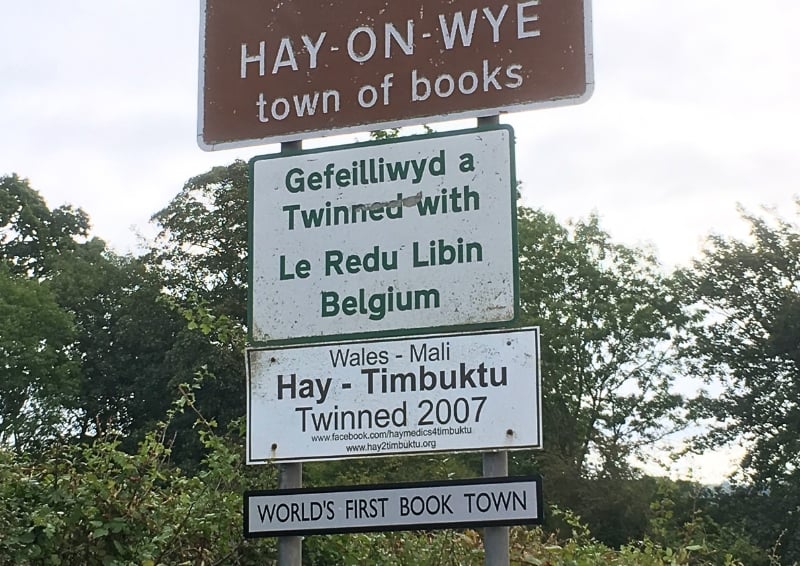
- Hay-on-Wye, Wales – Timbuktu, Mali (2007)
- Glasgow, UK – Boston, USA (2026, formalisation expected 2027)
A not-so dull partnership
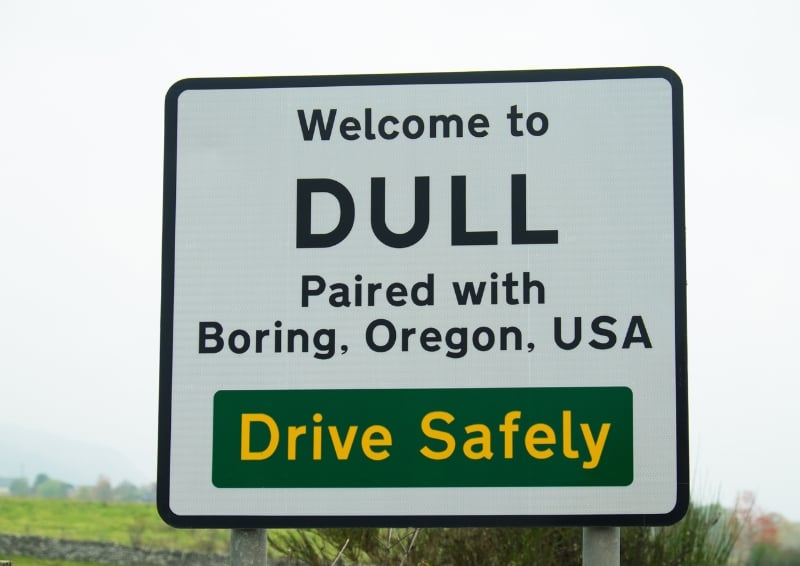
One of the most memorable twinning stories links Dull in Scotland with Boring in Oregon, USA.
What might sound like a throwaway joke began by chance in 2012, when a traveller spotted the sign for Boring and realised the names made a perfect match.
The idea quickly caught on, and two communities embraced the pairing with a sense of humour, turning it into a genuine partnership that has helped put both places on the map.
It even inspired the creation of the ‘League of Extraordinary Communities’ when Bland in Australia joined in, showing how a simple coincidence can grow into a global connection.
More than just a friendly fixture
The newly announced partnership between Glasgow and Boston shows how twinning can sometimes grow out of a moment.
In June 2026, thousands of Scottish football fans (known as the Tartan Army) travelled to Boston for the FIFA World Cup, quickly winning over locals with their energy, humour and traditions.
The connection led to a formal move to twin the two cities, but not before a few memorable cultural exchanges along the way. This included a tongue-in-cheek moment where Massachusetts’ governor appeared to ‘legalise’ haggis in the city, a playful nod to a dish that has technically been banned in the US since the 1970s.
While the agreement is set to be finalised in 2027, the spirit behind it already reflects what modern twinning is all about.
What cities learn through twinning
Cities across the world are facing many of the same questions.
How do we adapt infrastructure to a changing climate? How do we encourage more sustainable travel? And how can we regenerate ageing urban areas without losing the character that makes them unique?
No two cities are exactly alike, but the problems they face often are.
That’s where twinning can help. Rather than starting from scratch, city partnerships create opportunities to learn from approaches that have already been tested elsewhere.
It’s not about copying another city's solution outright, but understanding what worked, what didn’t and how those lessons could be adapted to local circumstances.
What does that look like in practice?
City twinning rarely delivers infrastructure projects directly, but it does open the door for cities to share experience and approaches to common urban challenges.
For example:
- Bristol and Hannover (twinned since 1947): explored how cities can reduce their environmental impact and how local authorities can work with residents on sustainability.
- Frankfurt and Birmingham (twinned since 1992): topics have included how large cities develop and renew urban areas, and how they adapt transport and public spaces as they grow and change.
- Nottingham and Karlsruhe (twinned since 1969): discussions have included how cities plan for growth, improve transport, and manage change in older neighbourhoods while keeping their character.
Why this matters for infrastructure
Infrastructure has always developed through shared learning. Engineers and policymakers regularly draw on experience from other places when designing and delivering new projects.
City twinning adds another route for that exchange. It connects people working in different cities and gives them a chance to compare approaches and understand how decisions play out in practice.
As cities continue to face long-term pressures this kind of shared learning is likely to become even more important.
Learn from projects around the world
From Lego-like tunnels to nature-based solutions in action, there's a lesson behind every engineer feat.

You may also be interested in

- Type
- News
Nominations open for ICE president
Candidates who meet the requirements are invited to stand to represent the institution as a future president of the ICE.

- Type
- Civil Engineer blog
Linking data to value: 5 priorities from the ICG's data and digital benchmarking report
The Infrastructure Client Group's 2026 benchmarking survey shows progress, but greater focus is needed on value, data quality and delivery outcome.

- Type
- ICE Community blog
What's the foundation of flood resilience? Information
ICE President David Porter explains why being informed about flood risk is so important for the public and civil and infrastructure engineers.