





Resilient Transport
Join industry leaders in Manchester this September to explore practical solutions for building stronger, more adaptable networks.
Be part of the shift

Members predict how our railways will be transformed over the next 200 years.
Being a rail engineer is more than just a job for Lauren Rodgers. It’s a way to secure a sustainable future for her children.
“As a mother, I want [my sons] Wilf and Beau to grow up in a world where transport is safe, green and accessible for all,” the Network Rail engineer says.
When rail started 200 years ago, it opened up “new frontiers”, Lauren says, and fuelled “industrial growth”.
Today, “it’s about decarbonisation, digital innovation and building sustainable transport networks that serve people and the planet”.
Will rail in 200 years’ time deliver the positive changes Lauren envisions for her children?
We spoke to some of our members working in the industry to find out what they see in its future.
As these rail experts highlight, climate resilience is a defining challenge for this sector.
That's why this September, specialists will gather at the Resilient Transport conference in Manchester to discuss how we can future-proof our vital transport networks.
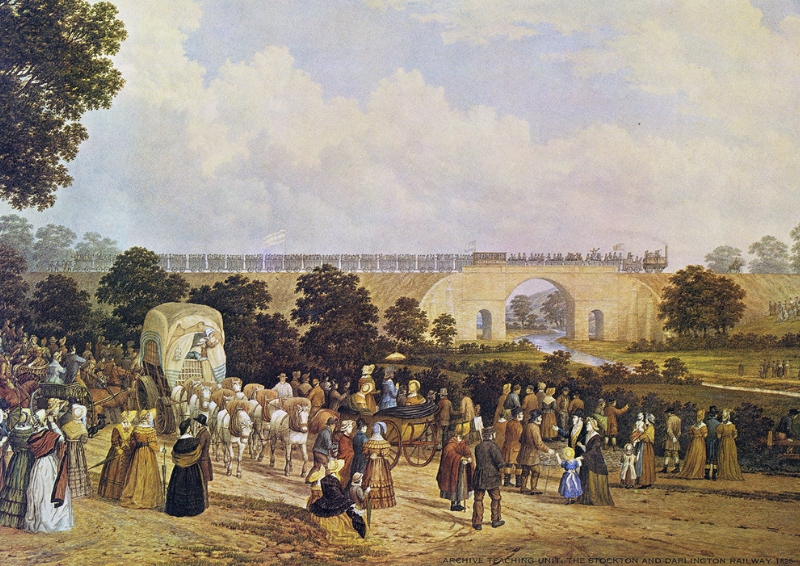
When the first passenger railway opened in 1825, it travelled at an average of 8km/h (for context, your standard chicken runs at 14km/h).
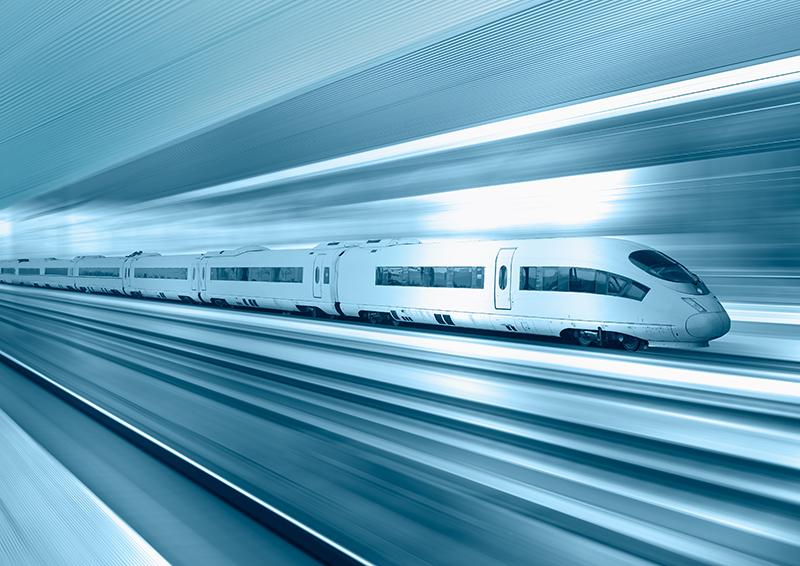
Sure, most rail lines in the UK now operate at a speed of 97-105km/h, but just how fast could our trains go?
“When I was in China, they were talking about trains going at 400km/h, which is incredible,” says Hudson Taivo, engineering manager at SYSTRA, a consultancy that specialises in mobility and public transport.
“You could close the gap from Edinburgh to London and get there in two-and-a-half hours.” Currently, it would take you, on average, five hours and 22 minutes.
Hudson recently presented his work on the UK’s High Speed 2 (HS2) – which would travel at up to 360km/h – at an international conference in Beijing.
For him, the most exciting thing about the rail industry is that the technology is well and truly global. “No single country is dominating the space,” he says.
He sees high-speed rail becoming a staple across the world.
“I’m sure it will take either my kids or their kids just the best part of a day to go from north Africa to southern Africa on a train,” he says.
A vast improvement on this journey today, which would involve over six days of driving (and a short ferry ride) without breaks.
Harriet Hatton, an apprentice at construction company, BAM Nuttall, is amazed at how technology has transformed the industry in the last 45 years – and made it safer.
“It’s wild to think that even in the 1980s most of this equipment didn’t exist,” she says.
“Now we’re generating massive 3D models from scans and managing data with advanced BIM software.”
BIM, or building information modelling, enables engineers to create digital representations of what they’re going to construct.
Svetlana Joao, a deputy project manager at TYPSA, an engineering and consulting services group, explains: “Technology helps me and my team collaborate on projects in real time.
“It means that we can quickly identify potential issues before they become bigger problems.”

In the future, Harriet would like to see how artificial intelligence (AI) can take this further.
“I’d love to see AI that automatically checks design drawings against standards and tolerances - flagging errors, referencing regulations, and helping us build safer infrastructure.”
“At the end of the day, the goal is always safety,” Harriet says.
Lauren is an area services manager at Network Rail, which owns and manages most of the railway network in Great Britain.
In 200 years, she expects rail to be “powered entirely by clean energy”.
Her colleague Chanchal Samuel, a senior geotechnical engineer, agrees, and envisages carbon-neutral rail systems.

Chanchal also points out how, with today’s technology, they’re able to “design earthworks that are safer, more resilient, and increasingly aligned with climate adaptation goals”.
For our railways to be sustainable, they need to be prepared to respond to the impacts of a changing climate. But what might that look like in 200 years?
“Predicting the environmental landscape that far ahead is challenging,” Chanchal says.
“But the excitement lies in bridging centuries of engineering progress while shaping sustainable infrastructure for generations to come.”
Lauren and Chanchal picture a smart rail system that is fully autonomous and integrated with other forms of travel (i.e. buses).
What if this meant that passengers no longer had to wait on platforms for trains?
Mak Chai-kwong, honorary professor at the University of Hong Kong, thinks digital technology should enable this, allowing passengers to request routes and stops.
“This would ultimately end the need for fixed routes and timetables. Particularly during off-peak periods, when timely and effective on-demand services would become the norm,” he explains.
Either way, railways are going to have to get smarter to adapt to much busier cities.
“As cities become increasingly overcrowded in the future, it’s going to be much harder to build new infrastructure,” says Tom Olliver, a rail mobility director leading the planning of Qiddiya's new light metro system in Saudi Arabia.
“There will be the need for more intense engineering work to build solutions underneath, next to, around and through pre-existing buildings and infrastructure,” he adds.
With less space and more need for transport, engineers will need to get creative to develop smart options – making sure to consider no- and low-build solutions, too.
Though our conversations made it clear that the future of rail is closely tied to new technologies, Svetlana issues a word of warning.
“We must be careful that we don’t rely on technology too much,” she says.
“We mustn't lose ownership of projects, and we must continue to apply critical thinking to make sure our projects are still safe and of a high standard.”
At the end of the day, it’s not just about using the latest tools to improve services.
Geoff Ogden, chief transport planning and development officer at Transport for Wales, explains: “It’s thinking about how people get information, how people purchase tickets, and their end-to-end journey.
“Working closely with communities will hopefully be at the heart of infrastructure delivery for the next 200 years and beyond.”
To mark Railway 200, we’re celebrating members working in the industry. You can check out their banners at the ICE’s home in London, One Great George Street.
Read their profiles:

The Royal Academy of Engineering (RAEng) has announced 75 individuals who are making outstanding contributions to the profession.

Held on 30 September 2026 at the ICE headquarters, One Great George Street, the awards recognised impactful infrastructure projects across the city.

There’s no shame in making a name for yourself in a consolidated industry, writes Steven Yule, ICE country representative for the UAE.
