





The 2025 prize goes to United Utilities, Stantec and Keller for their work to reinforce the historic asset.
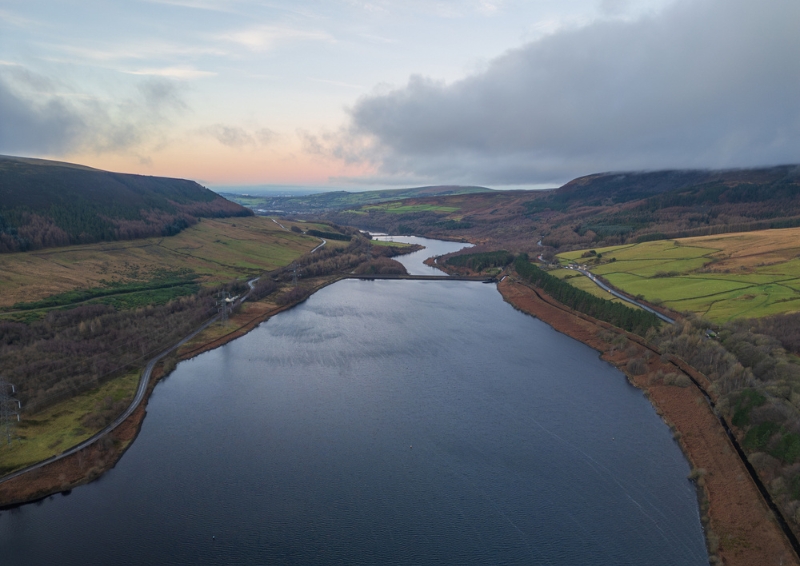
A scheme to stabilise a Bateman embankment dam in the Derbyshire Peak District has won the British Geotechnical Association’s 2025 Fleming Award.
The judges chose the project team – United Utilities, Stantec and Keller – from three shortlisted finalists for its work to strengthen the Victorian structure.
John Frederick Bateman’s engineering work on reservoirs is widely viewed as one of the founding achievements of the UK’s water sector.
Bateman, who served as ICE President in 1877-79, built the Longdendale chain of reservoirs to supply Greater Manchester.
On its completion in 1877, this six-reservoir sequence along the River Etherow was the largest of its kind in the world.
The winning project involved a 270m-long, 34m-high dam in the chain. The structure contains the 6,700 million litre Torside reservoir, which United Utilities owns and operates.
The problem
Although it was an outstanding example of Victorian engineering, the 150-year-old structure had suffered excessive settlement (downward movement) and leakage for much of its life.
The main goal of the scheme was to solve these problems and, ultimately, improve the resilience of water supplies in the region.
Routine monitoring of the dam had found that the settlement of installed pins had increased beyond the levels expected for a structure of its age and type. Research started in 2023 to determine the likely causes.
These investigations provided a thorough understanding of the geotechnical properties of the embankment and its foundation; the groundwater profile; and the dam’s performance at various reservoir levels.
The solution
The team formed a stabilisation plan that included the following installations:
- post-tensioned ground anchors extending into rock beneath the downstream embankment;
- a 65m-long line of structural piles at the toe of the embankment slope (where the structure meets the ground);
- a reinforced concrete ground beam connecting the structural piles and ground anchors; and
- a granular drain upstream of the ground beam to prevent water from collecting behind it.
The dam’s remote rural location was challenging.
The construction team had to transport large quantities of material to the site, perform complex stability calculations and work around the local bats’ maternity season.
The task of installing the piles also required specialist drilling equipment, which in turn called for the ongoing monitoring of noise, vibration and movement.
The team kept the dam’s crest open to the public while these works were in progress, as the structure forms part of the popular Pennine Way footpath.
The project finished within budget and on schedule in December 2025. This intervention has improved the dam’s structural integrity, while respecting its history and the local ecology.
Most crucially, it may have ensured that the reservoir will continue in service for another 150 years.
Setting an example
The winning project set the example on “how to get the best from our industry”, said Jim De Waele, one of the judges.
“From the outset, the team worked closely with a trusted supply chain to test assumptions and develop workable solutions.
“Overcoming the many geotechnical challenges the dam presented, this project succeeded mainly because all the team members worked well together,” said De Waele, a British Geotechnical Association trustee.
All three award finalists’ presentations to the judging panel can be viewed on the ICE website.
These are followed by a lecture on the legacy of Dr Ken Fleming, whose work as chief engineer of Cementation Skanska is celebrated by the award given in his name.

Sustainable Development Goals:
You may also be interested in

- Type
- Webinar
Short-term cash injections fail to deliver improvements to local roads
The Asphalt Industry Alliance’s (AIA’s) technical director, Dr Ian Lancaster, examines Welsh highway maintenance trends from ALARM data highlighting how long periods of cuts and underfunding have resulted in deteriorating road conditions and why a change of approach is needed.

- Type
- Webinar
Wales National Travel Survey
We bring you a webinar on The Wales National Travel Survey, launched in March 2025, which collects representative data on how and why people travel in Wales, with early findings to be published in April 2026 and full annual results from Autumn 2026.

- Type
- Webinar
Fuches Las Reservoir remediation work
Fuches Las Reservoir is an historic mining reservoir located in the Gwydir forest. The speakers will talk about the design and construction challenges to safeguard environmental and industrial heritage to provide a safe reservoir that contributes to flood prevention network in the Conwy valley.