





At her inaugural address, Julie Wood told members that better connected infrastructure is the key to improving outcomes for people and nature.
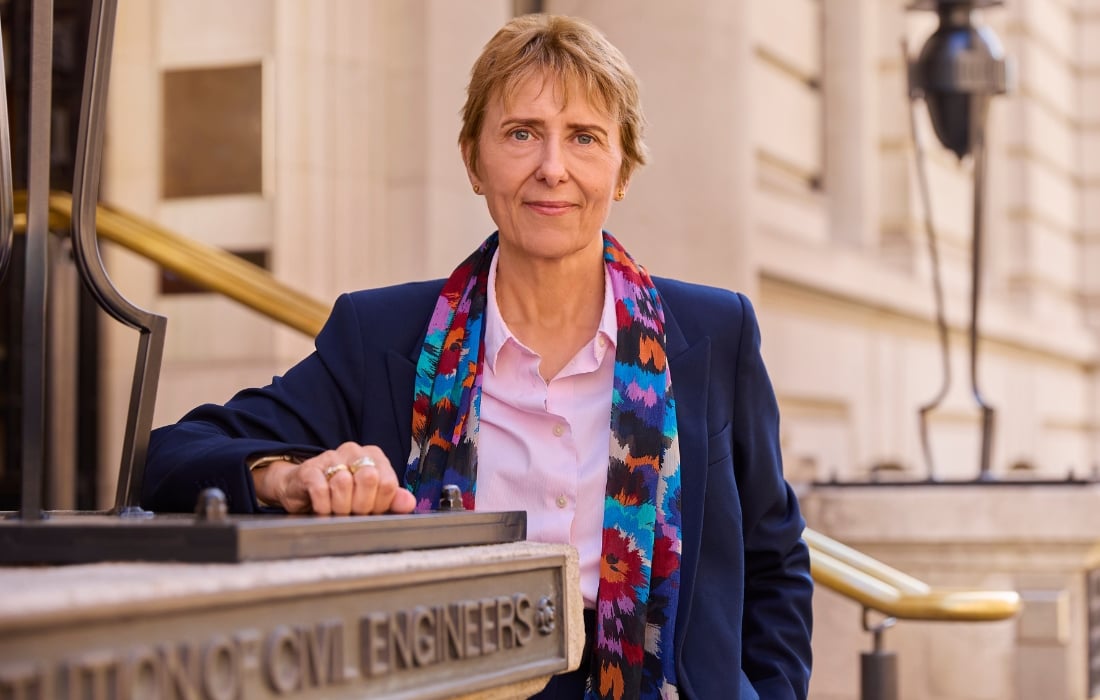
We must open doors for engineers of all backgrounds, and keep them open, new ICE President Julie Wood said at her inaugural address yesterday evening.
"I know what it means for a door to open," she said. "I entered our profession from a modest background, through an apprenticeship. And today, I become president of the Institution of Civil Engineers. I am proof of what is possible!"
Julie grew up in Teesside in north-east England, surrounded by engineering and industry. Fascinated by how infrastructure shapes places and communities, she knocked on doors of local engineering firms to get her first opportunity.
She went on to study a degree at Teesside Polytechnic, with a year in industry at Middlesbrough Council. Following graduation, she worked on major projects such as London Gatwick Airport’s North Terminal.
"Too often, we think social mobility ends when someone enters the workplace," she said as she became the 162nd president of the institution. “It does not.”
"The real test is what happens next. Who is trusted with real responsibility. Who is backed when the risks become greater. And who is still being supported 10 or 20 years later."
Infrastructure isn't about projects – it's about outcomes
Julie is now a major projects leader, having directed schemes such as London’s HS2 and the Francis Crick Institute, and the McLaren Technology Centre (HQ) in Surrey, south-east England.
Through this work, she learned that infrastructure isn't about projects – it's about the outcomes that it enables for people and nature.
In a video about the Transpennine Route Upgrade (TRU), a programme transforming rail links between Manchester, Leeds and York, Julie said the stations, tracks and signalling are only one part of the story.
"I'm really interested in the outcomes," she told Iain Chapman, senior programme manager at Network Rail, in the film. "How we are making it easier for people to be mobile across these three great cities in the north of England, [and do] practical things like (...) getting to hospital, getting to work."
Iain agreed: “It comes down to the fundamental question of why we do what we do as civil engineers. We do build bridges (...) but that's not why we do it. We do it for people.”
To deliver better outcomes for people, we need to be systems thinkers
"Infrastructure is often planned, funded and managed in separate parts, but that is not how people experience it. It is all connected," Julie told an audience of members and senior industry figures, joining in person at One Great George Street and online.
She encouraged everyone listening to become systems thinkers, recognising how their individual projects and decisions can affect the whole.
"The system does not stop at the project boundary, and neither do the consequences of the choices we make," Julie said.
To start, she called for a clearer understanding of what systems thinking means.
"We often make systems thinking sound harder than it is. We hide it behind jargon and complex explanations," she said.
In aid of this, as part of her address Julie shared an animation that breaks down what it means.
Reinvention shouldn't be normal
Once the desired outcome has been identified, and the systems that enable it considered, then it comes down to making better decisions.
Project delays are often a symptom of earlier issues, Julie explained.
"Organisational boundaries, fragmented investment, short-term incentives and stop-start pipelines all work against long-term, connected delivery."
Industrialisation, which would mean thinking like manufacturers, “cannot remove all those problems, but it gives us a practical way to tackle some of them,” she said.
In practice, this would mean repeating solutions that work, learning from them, and then, improving them.
"Too much infrastructure is still designed and delivered as a one-off. We need to stop accepting reinvention as normal, even if we enjoy it," she said.
But she clarified that industrialisation isn't about "standardising everything" or "removing engineering judgement", explaining that bespoke designs should still be considered if the context demands it.
Introducing Julie Wood's President's Future Leaders
Julie has also unveiled the six Future Leaders she's chosen to support her during her presidency.
Each ICE president chooses a group of the brightest graduate and technician members to work on projects that are key to the ICE’s plan.
This year’s President’s Future Leaders are:
- Lillian Macbeth
- Louis McKenzie
- Mohamed Amin
- Nishma Patel
- Saatvik Bhagi
- Tasneem Najmudin
- Wardah Hussain

You may also be interested in

- Type
- Webinar
Carlingford Lough Greenway
Discover the engineering behind the Carlingford Lough Greenway, a 20km cross-border walking and cycling route linking Newry and Carlingford. Learn how innovative design, stakeholder collaboration and construction planning delivered this landmark active travel scheme.

- Type
- Lecture
Design considerations for seismic testing facilities
What does it take to establish a seismic test facility? This presentation explores the key decisions, challenges and considerations involved.

- Type
- Lecture
Beyond Monitoring: Leveraging AI and Space Technology for Resilient Applications of Geosynthetics
Discover how space technology, AI, and satellite data are transforming infrastructure asset monitoring and geohazard risk management. Explore how soil moisture and multi-layer data insights are enabling smarter, more proactive infrastructure resilience.