





Year
1826, 1848, 1958 & 1991Duration
4, 2, 1 & 5 yearsCost
UnknownLocation
United KingdomProject achievements
Economy boosted
Trade, commerce boosted by the improved connections.
Solved the problem
Connect both sides and speed up the travel times.
Used engineering skill
Design and build, variously, a bridge or a tunnel.
Design and build an even better way for crossing the river Conwy in Wales
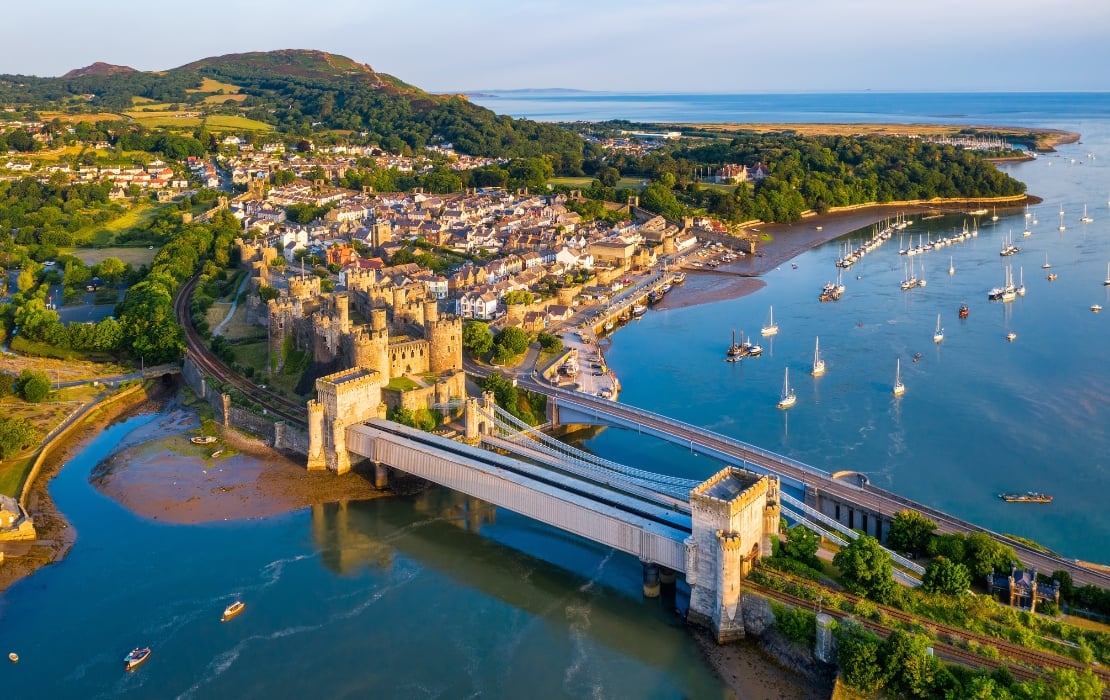
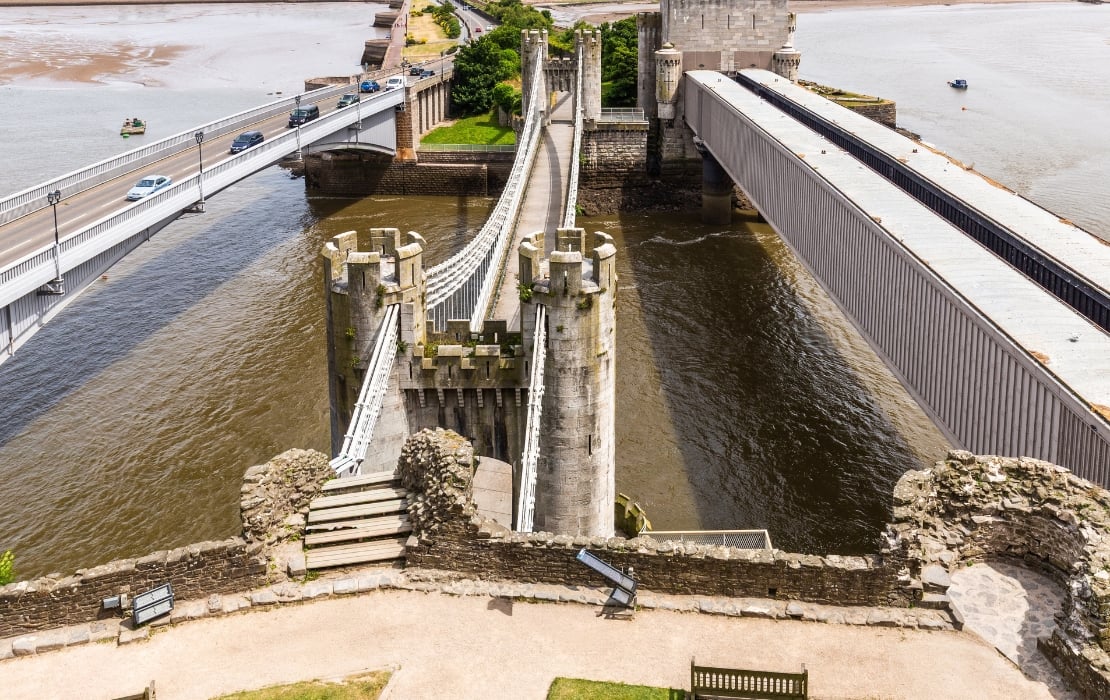
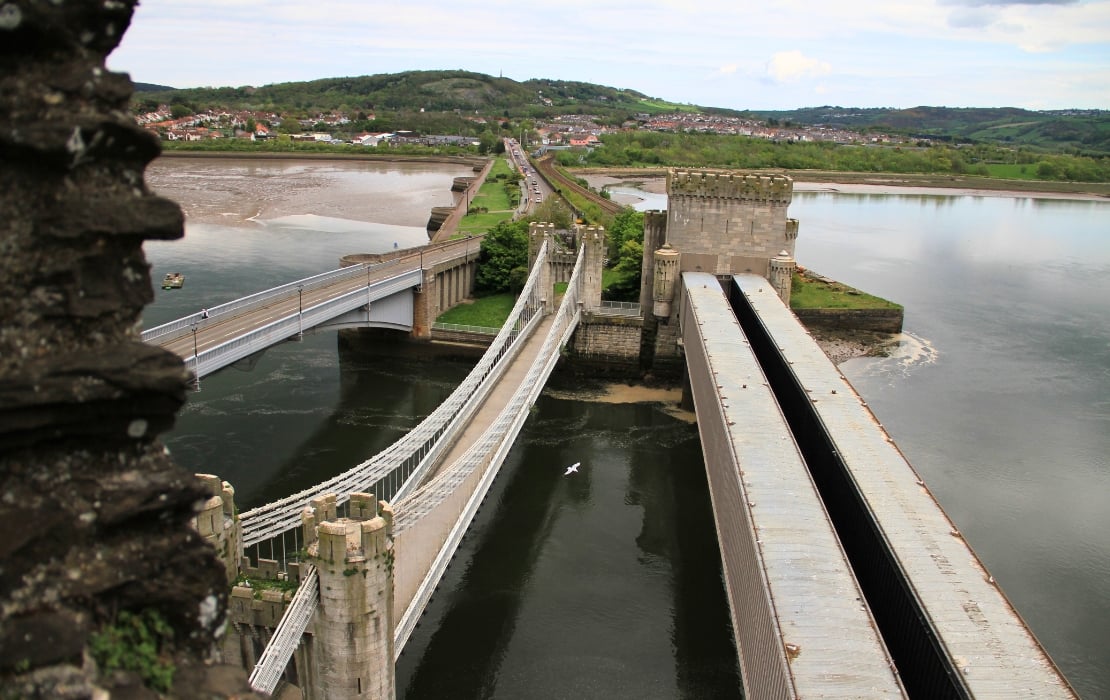
In 1826 when the Conwy suspension bridge opened it was one of the first suspension bridges in the world. It replaced a ferry at the same point and is similar to another Thomas Telford suspension bridge over the Menai Strait in Wales.
In 1848 engineers working on the Conwy railway bridge – sometimes called the Conwy tubular bridge – developed a wrought-iron box-girder construction to build the structure. The new method meant the bridge could cross the river in a single span.
The 1958 Conwy road bridge is single arch and made of steel. It carries the former A55 trunk road. Its north side is faced with stone to fit in with nearby Conwy Castle.
The 1991 Conwy road tunnel was Britain's first immersed tube tunnel. This is a tunnel where segments of the structure are prefabricated then floated into place and joined together.
200 years of the Conwy suspension bridge
July 2026 marks two centuries since Thomas Telford's bridge over the river Conwy officially opened.
But did you know it was almost demolished?
With the construction of the road bridge, 30 November 1958 was the last day a car crossed the suspension bridge, and later, a referendum took place on whether it should be torn down.
Despite the majority voting to demolish it due to maintenance costs, the National Trust was able to raise the funds to save it and conduct some conservation works.
It's still open today, for pedestrians and cyclists only.
Did you know …
-
The Conwy railway bridge still carries intercity and regional train services along the north Wales coast line.
-
Soil and earth dug out from the Conwy tunnel were used to build a bird sanctuary on the east bank of the river: the Glan Conwy Nature Reserve.
-
The Conwy tunnel casting basins – flooded areas used during construction work – also found another use. They were converted into what is now the 500-berth Conwy marina.
Difference the crossings have made
In 1826 the Conwy suspension bridge was the first crossing over the Conwy river. Replacing an unreliable ferry service, it made movement of goods and people in the region easier and boosted the local economy.
Around 20 years later the Conwy railway bridge carried the Chester to Holyhead line over the river. The bridge helped cut journey times between the two towns.
The 1958 Conwy road bridge was designed to ease pressure on the 1826 suspension bridge. After the road bridge opened, it was closed to all but pedestrian traffic.
The 1991 Conwy tunnel reduced traffic on the 1958 road bridge and cut road congestion and air pollution in the area.
How the work was done
Engineer Thomas Telford designed his suspension bridge to match the nearby Conwy Castle. The towers on each end were castellated – made to look like battlements.
Engineers anchored the suspension chains on one end of the bridge to a concrete plinth on the east side of the river. Chains on the other side were anchored to the barbican (outer wall) of the castle.
Engineer Robert Stephenson's Conwy railway bridge was the first – and only surviving – tubular bridge in Britain. He delayed its opening so he could run tests to confirm the structure would carry the weight of engines and rolling stock.
Engineers working on the 1958 95m-long road bridge used rounded support columns at each end to reflect the look of Conwy Castle.
The 1991 Conwy tunnel was constructed from prefabricated segments. Engineers floated the segments into the estuary as the tide rose and sank them into the river as the tide fell.
The units rested on concrete pads. They were then joined together underwater.
One of the most arduous tasks on the Holyhead Road project: the Conwy Cob
When Telford was commissioned to improve the London to Holyhead Road, he decided that the Conwy river could be crossed by two distinct elements: the suspension bridge and the cob.
The technology of the day meant Telford couldn't build a suspension bridge long enough to cross the estuary of the river, and as such, the cob was needed.
A cob is an embankment built using earth or stones that enables engineers to reclaim land from the sea. They can act as a sea wall or barrier, or carry a rail line or traffic.
In the case of the Conwy Cob, it acts as an approach to the bridge.
Construction began from the east shore, using fill described as ‘mountain clay’.
As the embankment advanced the upstream and downstream faces were protected with rock armour laid down using ‘well boats’. These were designed to transport the fill to site and then open the bottom of the boat to deposit the material in the correct location.
William Provis, Telford's resident bridge engineer, notes that when the embankment reached almost halfway, the sand of the river bed began to scour.
At this point the ‘well boats’ were redirected to lay down stone along lines of the embankment until it reached the surface of the water. The area between was then filled.
As the works progressed, all the sand on the river bed eroded, exposing a bed of hard river gravel. The mountain clay was found to be of little use and so more rock was placed.
The embankment was completed in 1825 and proved to be a valuable asset to the works that were to follow.
In the construction of the Chester to Holyhead Railway, Robert Stephenson placed his earthworks on the protected upstream face of the cob to carry his railway lines to the tubular bridge.
At a later date, the seaward side of the cob was also extended. It's now also a promenade and the approach to the road bridge.
People who made it happen
- Conwy suspension bridge designed by Thomas Telford, first ICE president
- Conwy cob designed and constructed by Thomas Telford and William Provis
- Conwy railway bridge designed by Robert Stephenson, ICE president
- Conwy road bridge constructed by engineers Sir William Arrol & Co
- Conwy tunnel designed by engineers Travers Morgan, now Capita Symonds


