





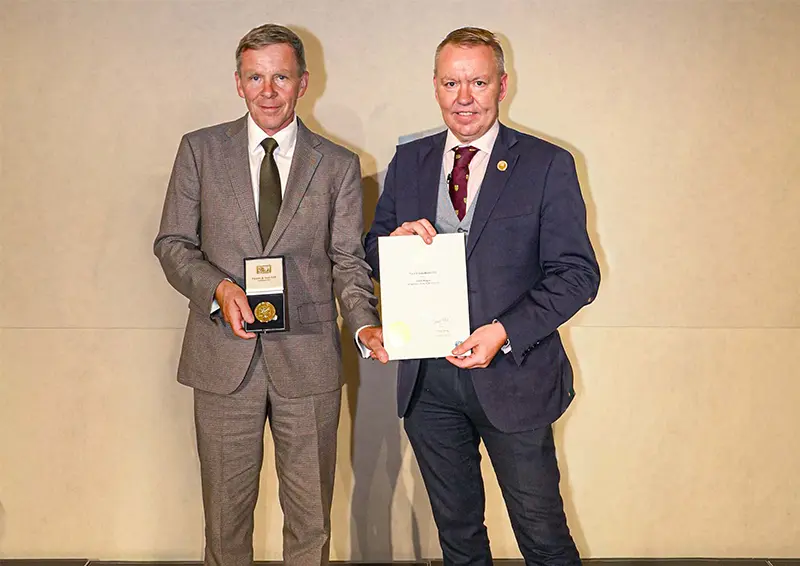
Gold Medal
Ewan Angus
Read more


The annual ICE Awards recognise outstanding civil engineering achievements and contributions to both the profession and the institution.
Learn about each award and how to enter below and submit your nomination before Thursday 8 October 2026.
The Gold Medal is an award that aligns with the ICE’s commitment to enhance the technical knowledge and ethical understanding of engineers wherever they work in the world.
The Gold Medal recognises an individual whose sustained insightful and ethical contribution to civil engineering is significant enough to merit a premier award from the institution.
The awards committee is particularly keen to recognise someone who has demonstrably worked to share lessons learnt for the good of the profession.
The Bev Waugh Award aligns with the ICE’s commitment to transform productivity in the industry by acknowledging an individual who has had a significant positive impact on teamwork.
The award recognises someone who quietly broadens the perspective of their team, leads with kindness, values the views of others and constructively questions the status quo to create a people-centred best-for-project culture.
The President’s Medal is awarded to an individual, not necessarily an ICE member, who has performed any service to the institution, civil engineers or the profession that hasn’t otherwise been recognised.
The recipient is decided by the ICE President. Consideration is given to service that reflects the priority objectives the President has identified for their year in office. This award is not open for nominations.
Introduced in collaboration with the Get It Right Initiative, the Tom Barton Award recognises excellence in implementing initiatives to improve quality, productivity, safety and sustainability by eradicating mistakes.
Nominations are particularly welcomed for young professionals who have demonstrably enhanced project efficiency.
Awarded to an ICE member or employee to recognise long, dedicated and valuable service to the institution.
Awarded to an ICE member in recognition of valuable service rendered to their region.
The Edmund Hambly Medal aligns with the ICE’s commitment to improve resilience, sustainability and inclusivity. It’s an award for the creative design of an engineering project that has made a substantial contribution to sustainable development and climate adaptation.
The medal celebrates the contributions of civil engineers and other built environment professionals to sharing inspiring, replicable solutions and changing people’s perceptions about what excellence looks like.
The Brunel Medal aligns with the ICE’s commitment to place decarbonisation at the heart of the industry’s agenda. It is awarded to recognise excellence in civil engineering and decarbonising infrastructure.
People, teams or organisations delivering a low-carbon solution in the built environment can enter by demonstrating how their work has hastened progress towards net zero. Their use of PAS 2080 would be of interest to the judges, but it’s not essential.
This award recognises work that has benefited society through sustainable water management. The work could be an engineering project, a programme of works, a policy or a piece of research.
The award is open to individuals or organisations anywhere in the world, including water companies, consultants, contractors, research bodies, regulators, governments and community groups.
The institution recognises that it may sometimes be hard to show that a given piece of work has been completed, but the submission must demonstrate its benefits. Nominations may be made by ICE members or non-members.
Entries may be made as an individual or as part of a project, by completing an application. Those nominating others for the award must have approval from the individual or a representative of the project concerned. The nominee should be aware that the information may be used in articles published on the ICE’s website.
All nominations, apart from those for the Chris Binnie Award, must be endorsed by an ICE member.
Download your application form:
ICE Annual Awards application form Chris Binnie application form
Email the completed form to [email protected]
Entries for the 2027 ICE Awards close at 11.59pm on Thursday 8 October 2026.
Nominations should make the best case possible for the nominee(s), providing sufficient detail to give the awards committee a full picture of the nominee(s) and their achievements.
The committee will decide the winner based on the quality of the citation, so please provide only relevant information and ensure that the amount of detail included does not obscure the case.
Citations should be a maximum of 500 words. Additional relevant information should be in the form of appendices, which should not be longer than four pages.
Supplying brief details about qualifications and work history, and any other relevant biographical information, may help the awards committee to form a rounded picture of the nominee(s).
Where teams have been nominated, details of the extent and length of their collaboration may be useful.
If there are conditions on who can win an award – for instance, if it’s open only to a particular membership grade – the citation must confirm that these entry criteria have been met.
If the award is for an individual’s record of service or achievements, provide specific details of how the nominee was involved in particular pieces of work.
Include enough examples to give a full picture of what the nominee has done to deserve it. Pay particular attention to key contributions that will have the greatest bearing on the terms of the award.
Where a nominee or team of nominees has not been wholly responsible for the project on which the citation is based, you should state the extent of their responsibility and involvement as clearly as possible.
If nominations have been supported by predicted outcomes of completed projects, the citation should show the extent to which those outcomes have been achieved.
Plans, maps, photos, publicity materials etc are especially useful to illustrate a nominated project.
Ewan Angus
Over a 40-year career, Ewan Angus has demonstrated sustained technical excellence, ethical leadership, and unwavering commitment to knowledge-sharing.
Beginning as a civil engineering technician in 1979, Ewan’s career has been defined by a “first principles” approach to complex challenges and has pioneered techniques that have since become industry standards.
In 2015, Ewan led a high-stakes repair on the Forth Road Bridge, Scotland, after its emergency closure. He designed and coordinated a complex series of instrumented load tests using 40 HGVs to provide the transparent, evidence-based confidence required by the Scottish Government to safely reopen the artery.
His leadership of the repairs work enabled the bridge to reopen to 90% of users in just 20 days - a feat that would typically require 18 months of traditional procurement.
As a result, Ewan’s team were awarded the inaugural ICE People’s Choice Award and the Saltire Society Greatest Contribution to Scotland Award.
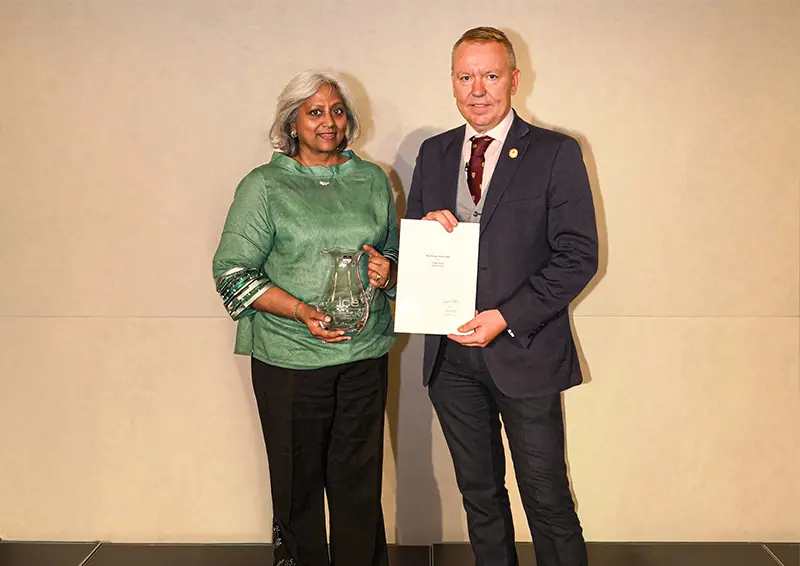
Chelvi Nava
Chelvi’s forty-year career spans consultancy, academia and international infrastructure delivery.
Across these varied roles, she has consistently focused on how engineers work together, recognising that trust, communication and shared understanding are fundamental to good engineering outcomes.
Chelvi founded Engineering Everyone, reflecting her long-standing commitment to learning and inclusion in the profession.
Under the Engineering Everyone – When They Are Young banner, she created The Language of Structures, a series of books that introduce structural engineering language, and the physical science underpinning the built environment, in a simple and engaging way for children.
The books encourage curiosity and questioning and are supported by school visits and outreach activities that connect professional engineering practice with early learning.
Chelvi’s leadership style is calm, inclusive and reflective. She values the views of others and listens carefully before offering guidance.
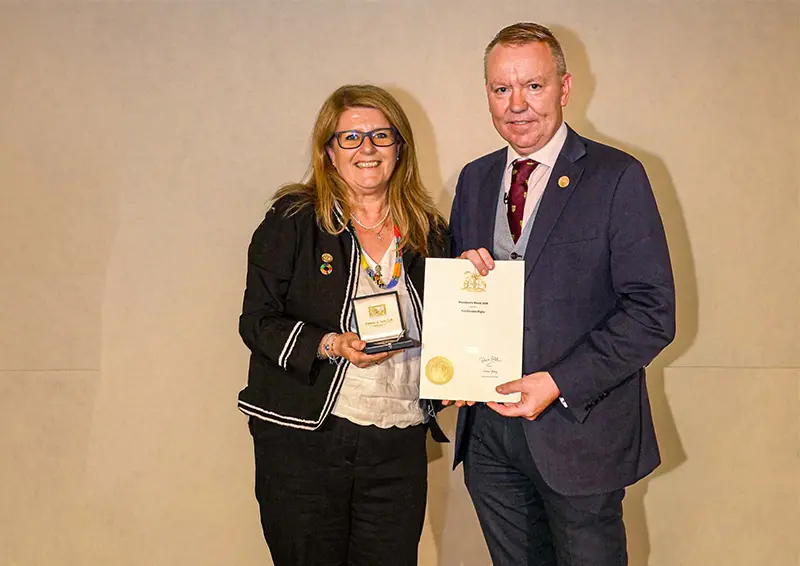
Yuli Doulala-Rigby
Chaido (Yuli) Doulala Rigby is an exceptional civil and geotechnical engineer whose distinguished career spans more than three decades of technical excellence, leadership, and service to the profession.
As Chief Civil Engineer at Tensar International, Yuli has made a significant and lasting impact on infrastructure and ground engineering projects in the UK and internationally.
Alongside her technical achievements, she is widely respected for her leadership and her commitment to advancing diversity, inclusion, and the future of civil engineering.
Through her involvement with ICE Connects: Women in Fellowship, Yuli has played a pivotal role in supporting and encouraging greater female representation at the highest levels of the Institution.
Her recent appointment as Chair of the British Geotechnical Association is a fitting recognition not only of her technical authority, but of her standing within the profession and the inspiration she provides to current and future generations of engineers.
Yuli’s sustained dedication to mentoring, advocacy, and broadening participation within civil engineering exemplifies the values of ICE and the spirit of ICE President David Porter’s 2025-26 presidential theme of “You, Me and ICE.”
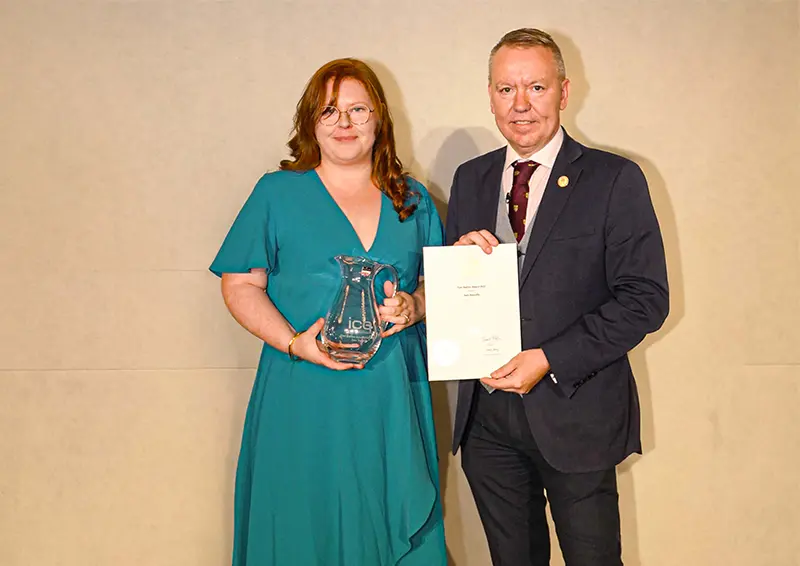
Samantha Ratcliffe
Samantha first came to prominence during the East Region contract for National Highways.
Recognising that quality drives efficiency, Samantha introduced clear process, regular audit and hands-on support across a large, geographically dispersed team.
Her non-engineering background became a strength, querying delivery approach in a constructive and engaging manner that enabled engineers to see and embed improvements.
Samantha was instrumental in developing National Highways Transportation’s ‘Excellence Plan’ with a focus on engaging their Early Careers, creating a targeted training module, whilst extending quality ambition to their Global Technology Centre in India, supporting a further 600 engineers.
She has engaged across client, sector and company boundaries to share knowledge and ideas.
Her engagement has spanned contractor partners such as Balfour Beatty, projects such as Lower Thames Crossing and Sizewell C and client organisations from local authorities to National Highways.
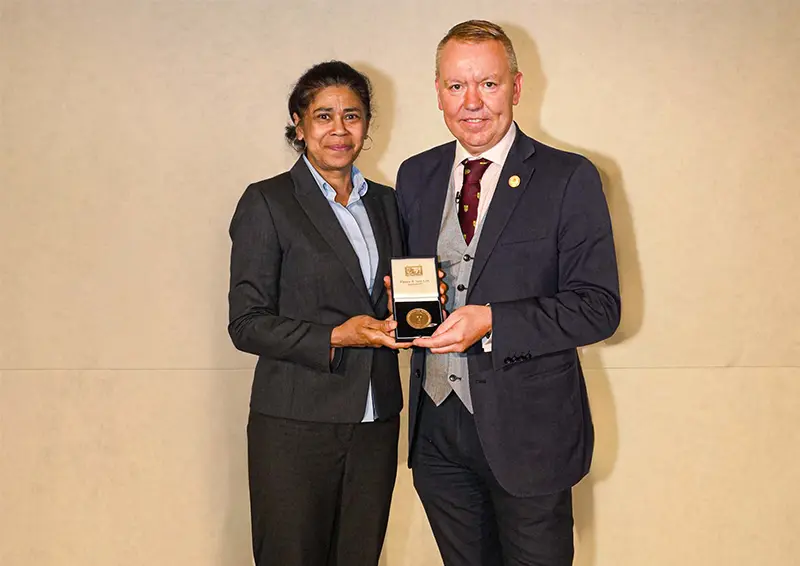
Debra Francis
Debra has worked for the ICE library service for 21 years. Her enthusiasm and helpful attitude are always above and beyond expectation.
She was promoted to Library Manager in 2024. In her role she manages the library team, archives and assets of the ICE’s London headquarters at One Great George Street, including the Members Resource Hub, the Infrastructure Learning Hub and the historic archive.
She deals with requests from members, non-members and ICE staff, conducts tours of the building, deals with donations and collection management.
Her devotion played a key part in the refurbishment of the library and Members Resource Hub and the massive shift in the space and collection that involved.
When flash-flooding occurred in 2016 in the One Great George Street basement, she stepped up to help provide a safe home for the collection and she went beyond and above her role to ensure the collection’s preservation in those challenging times.
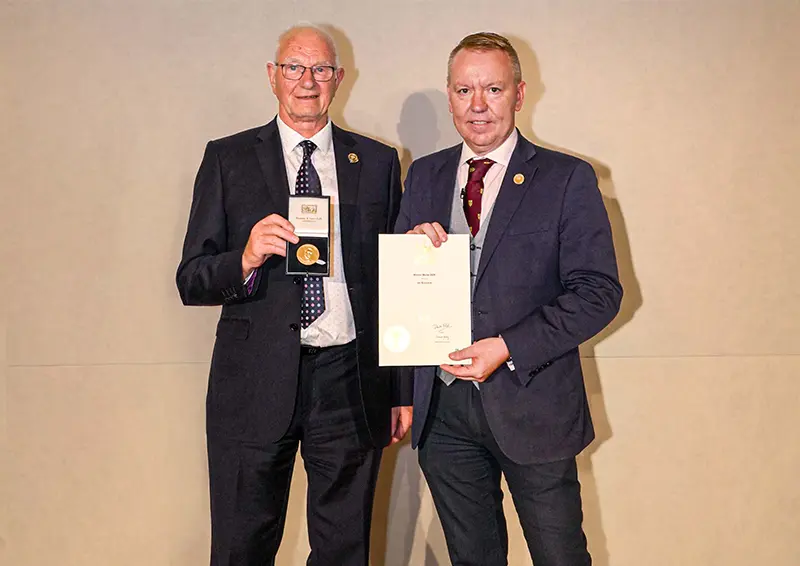
Ian Boocock
Ian Boocock joined Society of Civil Engineering Technicians (SCET) in 1968. He served on Committees of both SCET and ICE continuously until the early 2000s spending much time on promoting the value of professional membership to schools and colleges in the region.
Ian was Yorkshire Chair of the SCET from July 1983 - 1985 and served on SCET National Council until the merger with ICE in 1989.
He was elected ICE Yorkshire and Humber Regional Chair for the year 1999/2000 where he continued his promotional work within the region.
Upon retirement in 2006 he joined the Region’s retired members’ section (RICE) and was appointed Chair shortly after. Ian continues to regularly attend RICE meetings.
When he stepped down from his role as Yorkshire and Humber PHEW Representative, it marked 52 years of continuous service in a named role of the ICE family.
John Russon, Andy Powell, Natasha Clark, Andy Guffogg, Tony Andryszewski
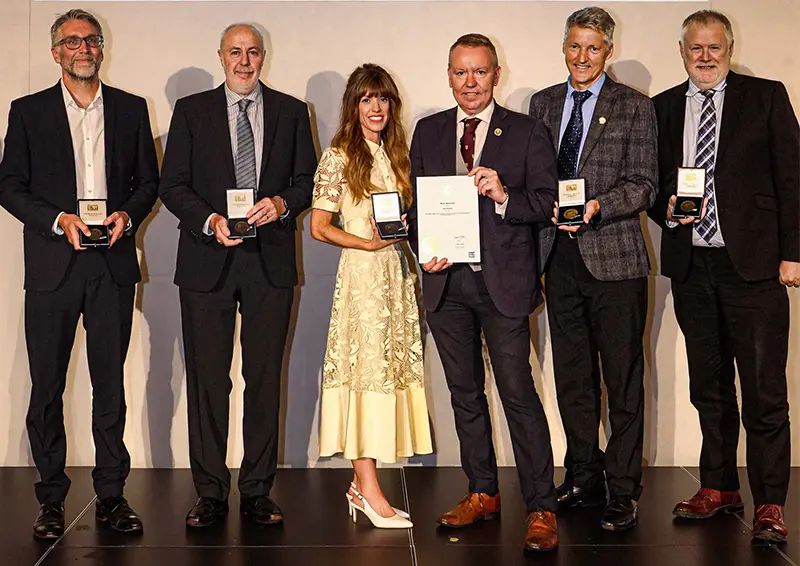
Project: Environment Agency: Net Zero Carbon for Infrastructure (NZC4i) and the Decarbonisation Technology Accelerator (DTA)
The Net Zero Carbon for infrastructure (NZC4i) programme has enabled the development and implementation of net zero methods, tools and processes to allow project teams to weigh up and analyse the flood defence infrastructure options and drive early, robust decision making to protect communities and the environment while reducing carbon emissions.
The learnings from NZC4i are fed into the Decarbonisation Technology Accelerator (DTA) Programme which has helped create a 20% reduction in carbon emissions in the EA’s capital programme by 2030 through a rigorous three-stage maturity model of testing, optimising and scaling.
The Decarbonisation Technology Accelerator is focused on six themes: Low Carbon Steel & Alternatives; Low (Concrete 1) and Ultra-Low (Concrete 2) Carbon Concrete; Modern Methods of Construction; Asset Management and Earthworks.
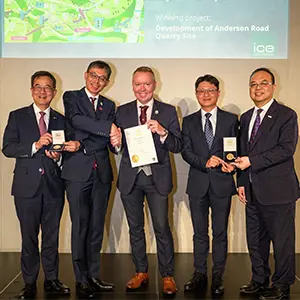
Michael Leung, Ivan Tsang, Roger Wong Huynh, Stephen Ka Lun Ming Keung Lee
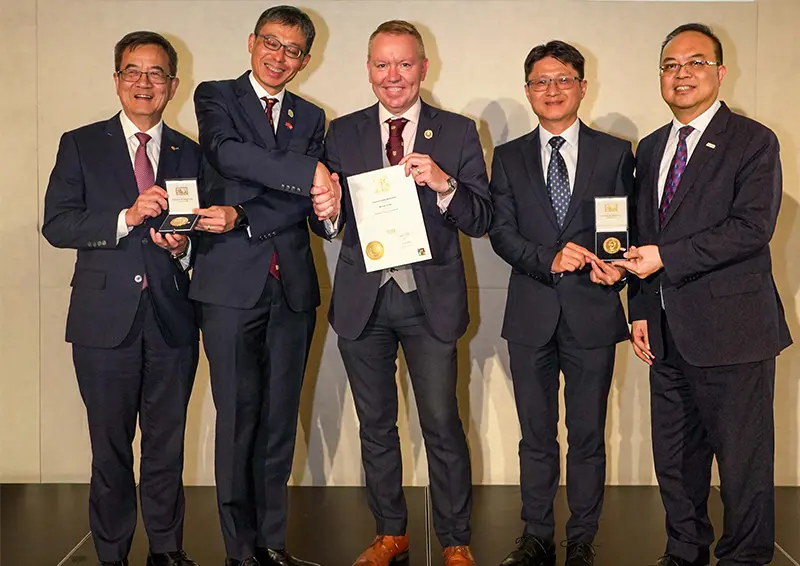
The Anderson Road Quarry (ARQ) site project revitalizes a disused quarry site to form a site formation of about 40 hectares for development of an all-in-one community with housing, commercial and recreational areas, with approximately 40% of open spaces, housing 30,000 residents.
Incorporating creative first-of-its-kind design ideas, the new community transforms a once rocky mountain into climate-resilient blue-green infrastructure (BGI) adopting Artificial Flood Retention Lake (Quarry Lake), Underground Stormwater Retention Tank (USRT), Permeable Paving, Greywater Treatment and Supply System, and Bioswales.
Following a “BGI” concept, these infrastructures are meant to perform in situ rainwater diversion and dispersion.
The rainwater harvested via infiltration and storage can be discharged and utilized when needed which alleviates the strain on the aged drainage systems downstream and the risk of flooding.
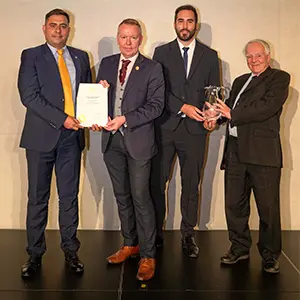
Professor Juan Carlos Santamarta, César Paradinas Blázquez, Professor Noelia Cruz Pérez
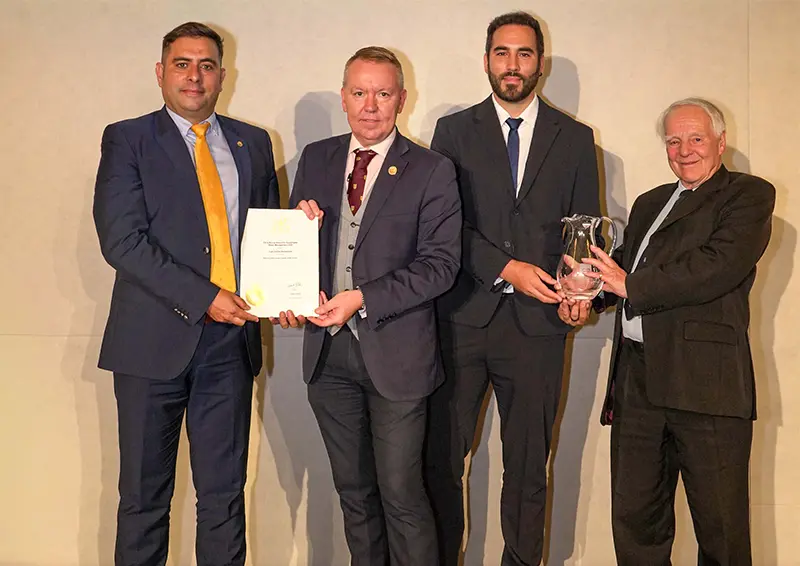
Project: Water and climate change in islands: SICMA Canarias
The Water and Climate Change in Islands: SICMA Canarias initiative was developed to respond to a critical regional gap: the absence of high-resolution climate data for the Canary Islands, a territory highly vulnerable to climate change and heavily dependent on groundwater for its water supply.
SICMA Canarias was designed as an open-access climate information system specifically adapted to the archipelago’s volcanic topography and insular conditions.
It integrates projections of key climatic and hydrological variables—precipitation, temperature, evapotranspiration, and water balance for time horizons up to 2100.
These data enable the identification of drought-prone areas, aquifer recharge zones, and long-term variations in water balance, providing a scientific foundation for planning and adaptation.
The system directly supports hydrological planning, agricultural management, and biodiversity conservation by offering reliable and localized projections.
It transforms climate uncertainty into actionable intelligence, providing the Canary Islands with an enduring digital infrastructure for climate-resilient water management.
If you have a question about any of our awards please contact us: