





These are some of the amazing structures that civil engineers have worked on throughout history.

Civil engineering has a long and vibrant history.
From its ancient predecessors to more recent, world-record-breaking feats of engineering, there are landmarks around the world that showcase the skills and creativity of civil engineers.
We’ve devised a (definitely not exhaustive) list of incredible structures that you can add to your travel bucket list.
1. Pontcysyllte Aqueduct, Llangollen, Wales

If you find yourself in the north of Wales, head to Llangollen and witness the grandeur of the Pontcysyllte Aqueduct.
This beautiful structure spans the Dee River and provides a crossing for canal boats and people.
Completed in 1805, it was designed by Thomas Telford (you may know him as the ICE’s first president) to connect industrial northeast- Wales with the canals leading to England’s midlands.
It’s the longest and highest aqueduct in the UK, coming in at 1,007ft (307m) long and 126ft (38m) above the river. When it was built, it was three times the height of any existing aqueduct.
A UNESCO World Heritage site, you can cross ‘the stream in the sky’ on foot or by boat, admiring the surrounding Area of Outstanding Natural Beauty.
2. Amphitheater of El Jem, El Jem, Tunisia

Another UNESCO World Heritage site, the Ampitheater of El Jem in Tunisia closely resembles its counterpart in Rome, the Colosseum.
Built between 230-238AD for spectator events, it’s constructed out of stone blocks and is free-standing, with no foundations.
Its façade is made up of three levels of arcades in the Corinthian or composite style, with tiered seating that could fit up to 35,000 people.
Our civil engineering predecessors built it to last – it even served as a fortress during the Middle Ages!
3. Ordsall Chord, Manchester, England

If you’re travelling to Manchester by train, chances are you’ll enjoy the benefits if not the view of the Ordsall Chord.
The 300m-long viaduct connects Manchester’s main train stations – Oxford Road, Manchester Piccadilly and Manchester Victoria – making it easier to travel into the city centre.
As the first asymmetrical railway bridge in the world, the chord is significant to civil engineering history.
It was also built near the site where George Stephenson first unveiled the Liverpool-Manchester railway – the first passenger railway line – in 1830.
The railway included the River Irwell Railway Bridge (or Stephenson Bridge), now a Grade-I listed structure, and another picturesque piece of civil engineering history you can enjoy in Manchester.
4. Octávio Frias de Oliveira Bridge, São Paulo, Brazil

‘X’ marks the spot when it comes to the Octávio Frias de Oliveira Bridge in São Paulo, Brazil.
The cable-stayed bridge features two curved decks supported by a single X-shaped concrete mast.
Spanning the Pinheiros river, it was built to alleviate traffic in the city but has also undoubtedly become a landmark that symbolises São Paulo.
If you visit, consider doing so at nightfall, when the bridge is lit up in a variety of different colours.
5. Machu Picchu, Cusco, Peru
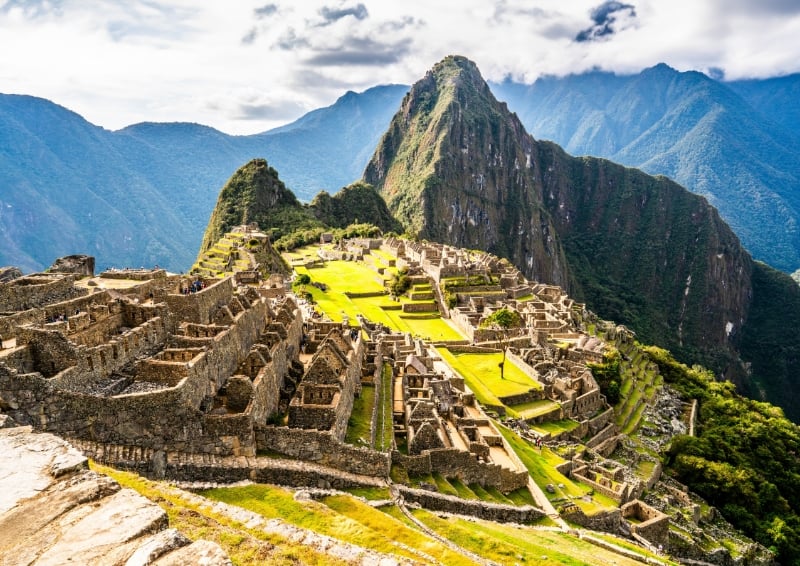
The dizzying altitude of 2,430m above sea-level is worth it for the extraordinary sights of Machu Picchu.
Set in the middle of a tropical mountain forest on the slopes of the Andes, this UNESCO World Heritage Site was built by the Inca Empire during the fifteenth century.
Made up of approximately 200 structures, the city follows a careful land use plan that includes roads and trails, irrigation canals and agricultural terraces. Two levels separated the farming from the residential areas.
It had religious, ceremonial and astronomical uses too, all built into this impressive feat of ancient architecture and engineering.
6. Auckland Harbour Bridge, Auckland, New Zealand

Opened in 1959 and expanded 10 years later, the Auckland Harbour Bridge is an eight-lane motorway bridge that connects the city of Auckland with North Shore, an area that was expanding at the time.
For the best views, get tickets to Auckland’s Sky Tower and admire the bridge from above.
And if you enjoy a ghost story, look out for the figure of a man floating above the water at dusk. Locals have reported seeing the apparition, believed to be a fisherman who drowned the harbour. Spooky!
7. The Falkirk Wheel, Falkirk, Scotland

The Falkirk Wheel in Scotland is the only fully rotating boat lift in the world.
Built to link the Forth and Clyde and Union Canals, the wheel uses two gondolas to raise boats 24m so they can reach the aqueduct that leads to the latter.
The wheel was designed based on principles devised by Archimedes, the ancient Greek engineer and mathematician.
If you’d like to visit, you can watch the boats rotate from the visitor centre for free, or you can experience the wheel yourself on a 60-minute boat trip.
8. The Eiffel Tower, Paris, France

Although it needs no introduction, we’d be remiss not to highlight the civil engineering skill on display at the Eiffel Tower.
Its creator, Gustave Eiffel, was a true master of materials economy.
If you were to melt down the tower, with its 18,083 components and 2,500,000 rivets, its metal would only fill the tower’s base about 2.5in deep.
While admiring the tower from the Champ de Mars in Paris you could also appreciate how its curvature offers the most efficient wind resistance possible.
Or, you could take a photo pretending to hold the tower between your thumb and index finger.
We’ll leave that up to you.
9. Antrim Coast Road, Ulster, Northern Ireland

Without civil engineering, some landmarks wouldn't be accessible.
Indeed, the Antrim Coast Road in Northern Ireland provides a scenic route to the natural wonders that are the Glens of Antrim, home to UNESCO World Heritage site, the Giant’s Causeway.
Since the road opened in 1842, it’s provided access along the Causeway Coast – a revolutionary idea at the time, since previous plans were to build the road some distance away.
The 313km-long path winds along the nine valleys of Antrim, with beautiful stretches of grass and a few grazing sheep rounding out the picture-perfect views.
10. Burj Khalifa, Dubai, United Arab Emirates

When it opened in 2010, the Burj Khalifa broke eight world records – the most notable making it the tallest building in the world, coming in at 828m.
That’s about three times the height of the previously mentioned Eiffel Tower!
Its striking design is inspired by a regional desert flower, the Hymenocallis, also known as a Spider Lily.
As the tower gets taller, the ‘petals’ of the flower re-configure the shape of the building. This makes it more resistant to wind and other elements.
A visit to the Burj Khalifa wouldn’t be complete without a stop at one of its observation decks, one of which at 555km is, unsurprisingly, the highest one in the world.
11. Cross Bay Link, Tseung Kwan O, Hong Kong
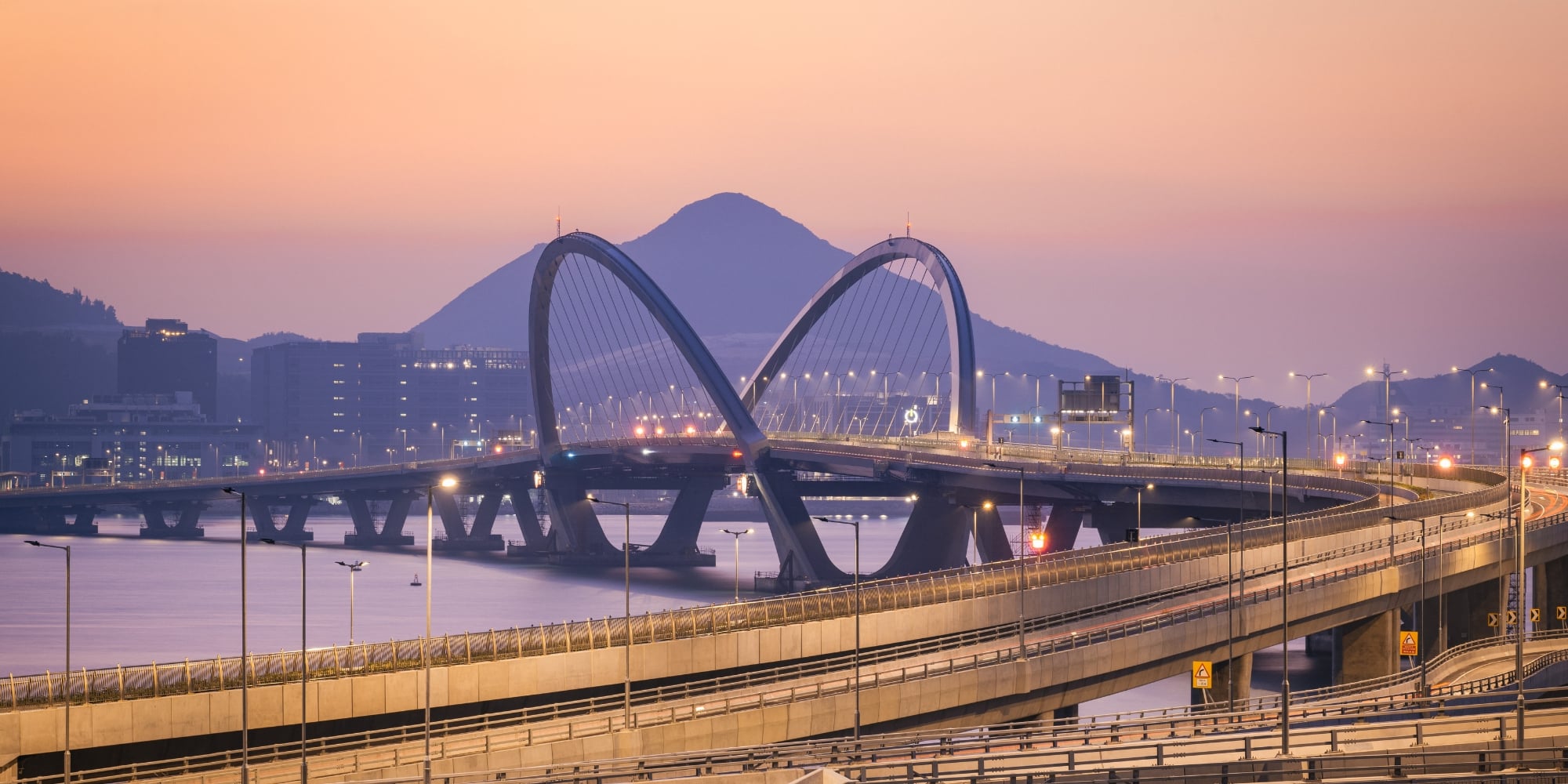
How about a visit to Hong Kong's most popular infrastructure project from the last 25 years?
Not to mention a Brunel Medal winner, recognised for saving 30,000 tonnes of carbon emissions through material choices and design.
The Cross Bay Link connects the new town of Tseung Kwan O with Kowloon East, spanning 1.8km across Junk Bay.
You can drive, walk or cycle through it, but for one of the best views of its infinity-inspired double-arch, then head to the Tseung Kwan O South Waterfront Promenade.
12. Rideau Canal, Ottawa, Canada

The Rideau Canal in Ottawa, Ontario has been around since 1832.
It connects Canada’s capital with Lake Ontario and the St Lawrence river.
The canal was designed using a ‘slackwater’ system, meaning engineers built dams to drown rapids along the route. The 202km-long canal has 52 dams and 47 locks.
If you’re visiting in the summer, treat yourself to a boat ride or perhaps a paddling adventure.
But if you’re there in the winter, then you may enjoy the Rideau Canal Skateway, which holds the Guinness World Record for the world’s largest naturally frozen ice rink.
13. Akashi Kaikyo Bridge, Awaji and Honshu, Japan

If your road trip through Japan is taking you to Awaji Island, then chances are you’ll cross the Akashi Kaikyo Bridge.
The world’s second longest suspension bridge, it connects Kōbe, in mainland Honshu, and Iwaya on the island. Its central span is 1991m long, with 960m end spans.
You can enjoy the bridge by walking on the Maiko Marine Promenade, a circuit of walkways under the bridge’s platform – just 50m above the water!
And if you’d like to learn why it’s earned the nickname of Pearl Bridge, then make sure you stick around to see the bridge illuminated at night.
Get in touch
Which of these structures have you visited before? Which one would you like to see next?
And which landmarks would make your bucket list?
Let us know!
You may also be interested in

- Type
- News
RAEng names 4 leading ICE members as Fellows
The Royal Academy of Engineering (RAEng) has announced 75 individuals who are making outstanding contributions to the profession.

- Type
- Awards and competitions
Accessibility-first railway revamp wins at the ICE London Awards 2026
Held on 30 September 2026 at the ICE headquarters, One Great George Street, the awards recognised impactful infrastructure projects across the city.

- Type
- ICE Community blog
When every consultancy looks the same, where does innovation go?
There’s no shame in making a name for yourself in a consolidated industry, writes Steven Yule, ICE country representative for the UAE.