





The new standard on preparing infrastructure for uncertain climate scenarios will integrate with the existing standard on carbon management.
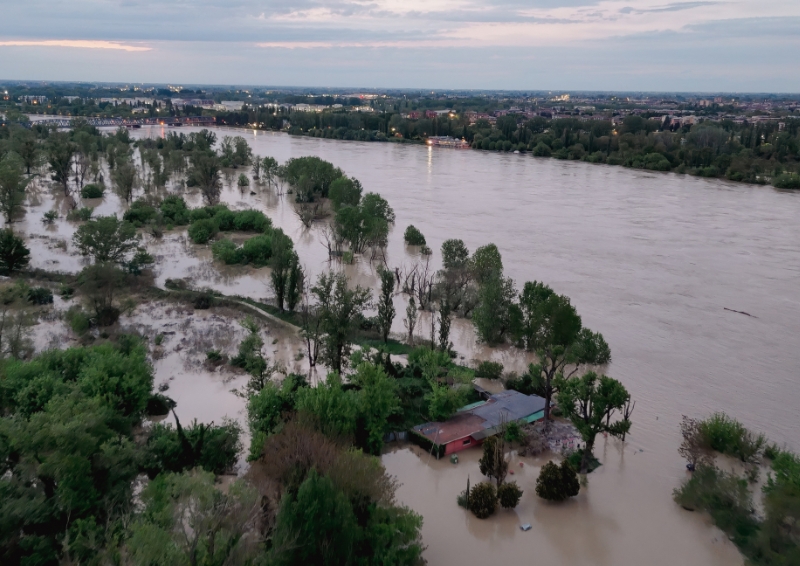
We're witnessing the effects of a changing climate more and more every day.
From mass floods destroying people's homes to extreme heat causing vital infrastructure to melt down, it's clear that we can't rely on what the weather used to be like.
But it's also impossible to prepare infrastructure for every single climate scenario that may or may not come to pass.
Attempting it could result in overdesign, which would not only be expensive financially, but lead to unnecessary carbon emissions, too.
That's where adaptation pathways come in.
Read more: how should engineers approach climate adaptation?
What are climate adaptation pathways?
Adaptation pathways help to identify the trigger points at which climate conditions breach certain thresholds where infrastructure services would become ineffective or redundant.
This approach recognises that a range of adaptation measures may need to be applied over time, in response to the changing conditions.
Importantly, it mitigates the risk of over or under investing in adaptation at any one time.
By keeping climate, technology, socioeconomic and political factors in mind, it also helps to de-risk investments.
And, it encourages project partners to collaborate from the start.
Introducing PAS 3090 - adaptation pathways for infrastructure systems
A new publicly available specification (PAS) will help guide the industry on how to use these pathways.
Its aim is to provide a flexible approach to climate adaptation planning and enable practitioners to make long-term decisions under uncertain scenarios.
It will integrate with other standards, such as PAS 2080 on carbon management, and help different sectors align on climate adaptation.
What will PAS 3090 cover?
This PAS will provide:
- A framework for climate adaptation decision-making under uncertainty
- Guidance on embedding pathways into planning and governance
- Clarity on roles, responsibilities, metrics and key data
- Methods for using climate scenarios and assessing impacts
- Approaches to address design life constraints in codes
- Ways to identify co-benefits with decarbonisation and sustainability
- Tools for flexibility, thresholds, nature-based solutions and business cases
It will be applicable across all infrastructure systems and project life-cycle stages.
Who is PAS 3090 for?
This PAS will be useful for planners, engineers, designers, asset managers and climate specialists across all infrastructure sectors.
It will also be relevant for sustainability and adaptation professionals, government decision-makers and built environment practitioners.
Adapting to a variety of climate scenarios
Read ICE Past President Professor Jim Hall's series on how to approach climate resilience for:
Who is developing PAS 3090?
The development of PAS 3090 is owned by the British Standards Institution (BSI).
It's sponsored by the ICE, with support from funders and expert stakeholders across the industry and academia.
As sponsor, the ICE will:
- Align the PAS with the institution's five-year strategy
- Ensure the PAS reflects the needs of infrastructure professionals and stakeholders
- Coordinate stakeholder engagement through expert panels and forums
- Encourage the sector to adopt climate adaptation through engagement, professional development and the guidance document that will come alongside the PAS publication
Technical author
The BSI has appointed John Dora, a director at adaptation consultancy, Climate Sense, as the technical author for this specification.
Steering group
Through consultation with the ICE, the BSI selected expert stakeholders to join the this PAS' steering group.
The group is made up of representatives from government, academia, industry and asset owners.
It's responsible for providing technical insights and comments as well as reviewing and approving drafts of the PAS document during each stage of development.
Technical advisor panel (TAP)
Set up and convened by the ICE, this panel is made up of technical experts and funder representatives. It serves as a conduit to the wider stakeholder community.
Panel members provide intermediate reviews of the draft document before it goes to the steering group. Final editorial authority remains with the steering group.
This panel is also responsible for assisting the technical author with developing the ICE guidance note.
This associated document will expand on specific topics and provide case study examples of when the approach has been used in real-life projects.
Public consultation
Further along in the development process, the PAS 3090 document will be made available on the BSI’s Standards Development Portal for comments from its Review Panel.
This panel will be made up of a wider group of 100+ industry stakeholders.
Following the consultation, comments will be reviewed by the technical author.
What stage of development is it in?
PAS 3090 development is following the milestones set by the BSI.
The process was kicked off in February 2025 with the BSI Project Initiation Meeting.
In May 2025, the first steering group meeting took place in the form of a scoping workshop.
TAP engagement also started in 2025, with the first meeting held in June.
It's currently in phase two: consensus building, which seeks to achieve general acceptance of the standard and ensure that the interests of all stakeholders are considered.
PAS 3090 funding partners
- Arup
- Autodesk
- Department for Transport, UK government
- Environment Agency, UK government
- HS2 Ltd
- Jacobs
- Mott MacDonald
- Stantec
- Transport for London
- University of Birmingham
- WSP
Related events
An April 2022 strategy session delved into how engineers can build resilience into their work in the face of increasing climate threats.
The South East Asia instalment of the 14th Brunel International Lecture Series explored the challenges the region must address, including higher sea level rise and growing urban migration.

Sustainable Development Goals:
You may also be interested in

- Type
- News
RAEng names 4 leading ICE members as Fellows
The Royal Academy of Engineering (RAEng) has announced 75 individuals who are making outstanding contributions to the profession.

- Type
- Awards and competitions
Accessibility-first railway revamp wins at the ICE London Awards 2026
Held on 30 September 2026 at the ICE headquarters, One Great George Street, the awards recognised impactful infrastructure projects across the city.

- Type
- ICE Community blog
When every consultancy looks the same, where does innovation go?
There’s no shame in making a name for yourself in a consolidated industry, writes Steven Yule, ICE country representative for the UAE.