





Vital infrastructure suffers from wear and tear and needs regular health checks to ensure it remains safe for everyone to use. Technology is now transforming how we do this.
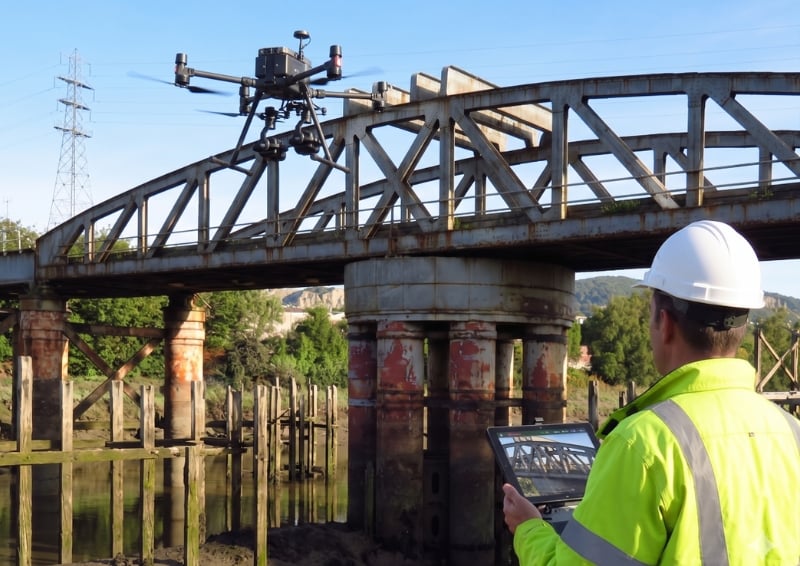
For decades, inspecting a massive bridge has been a slow, difficult, and sometimes highly dangerous job.
Historically, it has involved teams of engineers physically climbing the structures.
This often required heavy scaffolding, dangling from ropes in unpredictable weather, and extended road closures.
Not only does this traditional method cause frustrating traffic jams for the public, but it also relies heavily on human eyesight.
Trying to spot tiny, hairline cracks across thousands of tonnes of steel and concrete while suspended mid-air is incredibly challenging.
This is where a new wave of technology is changing everything: the use of flying drones.
A need for speed and safety
When an engineer needs to inspect a bridge today, they don't necessarily have to put on a safety harness and brave the heights.
Instead, they can stand safely on the ground and pilot a small, agile drone around the structure.
The biggest and most immediate benefit of using drones is speed.
A comprehensive inspection task that used to take a team of engineers several weeks to complete can now be flown by a drone in a matter of hours.
The drone can smoothly swoop under arches, hover near towering pillars, and safely inspect hard-to-reach areas.
Crucially, it does all of this without putting human lives at risk or forcing the closure of a single lane of traffic.
But the impressive speed of the flight is only half of the story. The real magic happens with the sheer amount of information these drones can gather in that short space of time.
The power of 'big data'
When a drone flies around a bridge, it isn’t just taking a few holiday snapshots. It's equipped with highly advanced cameras and precise laser scanners.
These sensors capture millions of individual data points every single second.
This creates what experts call 'big data', a massive, highly complex pool of information. To give you an idea of the scale, a single bridge inspection can generate thousands of ultra-high-resolution images and exact 3D measurements.
The imagery is so detailed that engineers can spot a crack no wider than a human hair, all from the safety of their office desk.
However, gathering this enormous mountain of data creates a new, modern problem: how on earth do we process it all?
If a drone takes 10,000 photos of a bridge, it would still take a human inspector weeks to sit at a computer monitor and look at every single picture to find signs of rust, wear, or damage.
The immense speed we gained from flying the drone would be completely lost once we returned to the office.
Teaching computers to see with AI
This specific challenge is what Professor Haijiang Li and his research team at Cardiff University, working closely with their industry partner Centregreat, have focused their efforts on.
Over the last few years, this collaborative team has been developing innovative ways to use artificial intelligence (AI) to do the heavy lifting. They are specifically looking at how to automate the inspection of bridges and coastal railways.
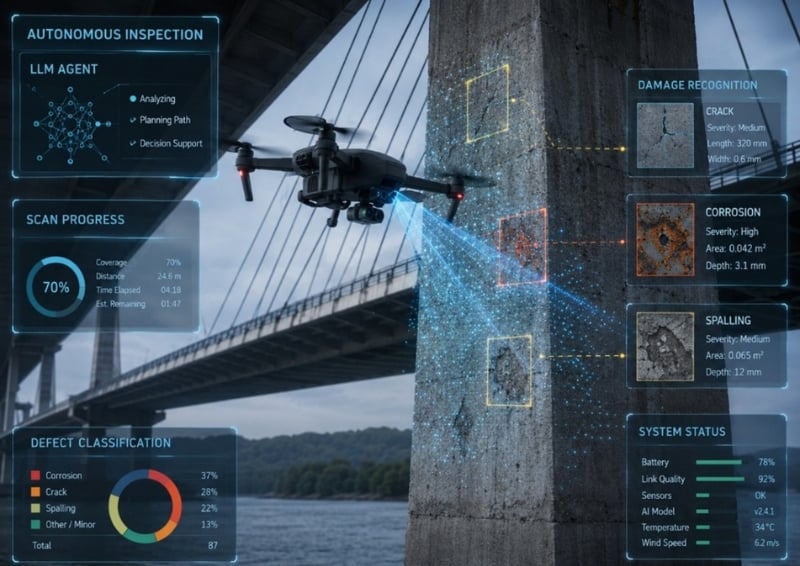
Instead of a human straining to look at every photo, the team uses 'engineering AI' to automatically scan the big data gathered by the drones.
Unlike the general AI that powers modern smartphone assistants or chatbots, which can sometimes make mistakes or 'hallucinate' answers, engineering AI is strictly governed by real-world physical constraints.
Because it understands the laws of physics and structural engineering, the system acts like a highly trained virtual inspector that doesn't just guess.
Turning data into digital twins
These AI systems can instantly sift through thousands of images, highlight areas of concern, and generate accurate, automated text descriptions of the damage.
The AI can reliably tell the difference between a harmless shadow, a hairline crack in a concrete pillar, or severe corrosion on a steel beam.
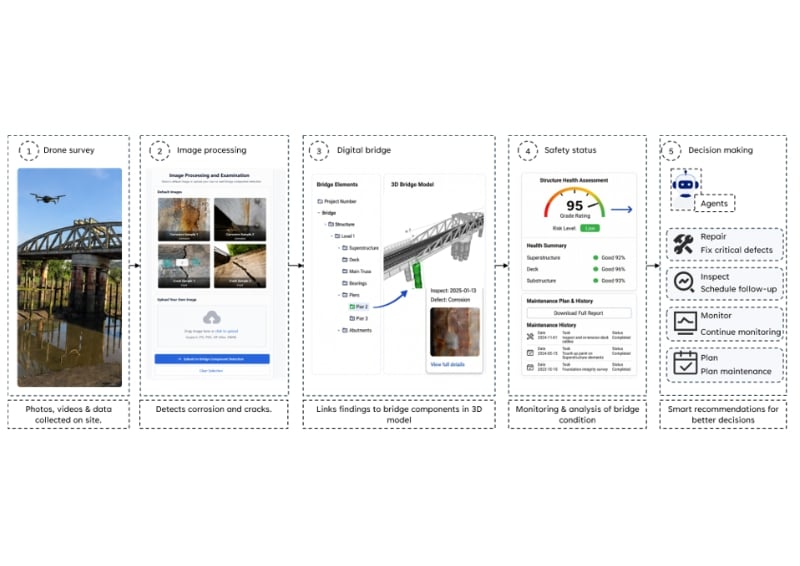
The research takes this a fascinating step further by creating digital twins. A digital twin is exactly what it sounds like: a highly accurate, 3D digital copy of the physical bridge, living entirely on a computer.
By feeding the drone's big data into this digital twin, the system can create a live, interactive health map of the structure.
Engineers can virtually 'walk' around the bridge on their screens, looking at the exact condition of every nut and bolt.
Professor Li's team is even exploring how AI can automatically plan the drone's next flight path.
By understanding the 3D space of the digital twin, the AI can tell the drone exactly where to fly to get the best possible angles on areas that need a closer look, making the entire process highly efficient and autonomous.
A safer, smoother future
By combining the physical agility of drones with the analytical brain of AI, we are completely transforming how we maintain our vital infrastructure.
Of course, integrating this powerful technology into our public spaces goes hand-in-hand with strict safety regulations.
Operating drones, especially near critical public infrastructure, requires engineers and pilots to strictly follow national aviation rules. In the UK, these are set by the Civil Aviation Authority (CAA), ensuring that every single flight is conducted safely, legally, and responsibly.
With drones and AI, we can catch potential structural problems much earlier. This means repairs are smaller, cheaper, and safer to carry out.
For the public, it means fewer unexpected road closures, less traffic disruption, and the peace of mind that the bridges we cross every day are being monitored more closely and accurately than ever before.
The next time you see a small drone buzzing near a railway or highway, it might just be performing a vital health check, keeping our communities connected and safe.
Want to learn more about how civil engineering is shaping the future of our communities?


You may also be interested in

- Type
- News
Nominations open for ICE president
Candidates who meet the requirements are invited to stand to represent the institution as a future president of the ICE.

- Type
- Civil Engineer blog
Linking data to value: 5 priorities from the ICG's data and digital benchmarking report
The Infrastructure Client Group's 2026 benchmarking survey shows progress, but greater focus is needed on value, data quality and delivery outcome.

- Type
- ICE Community blog
What's the foundation of flood resilience? Information
ICE President David Porter explains why being informed about flood risk is so important for the public and civil and infrastructure engineers.