





The government has responded to a parliamentary committee’s call for more coordination on flood resilience in England.
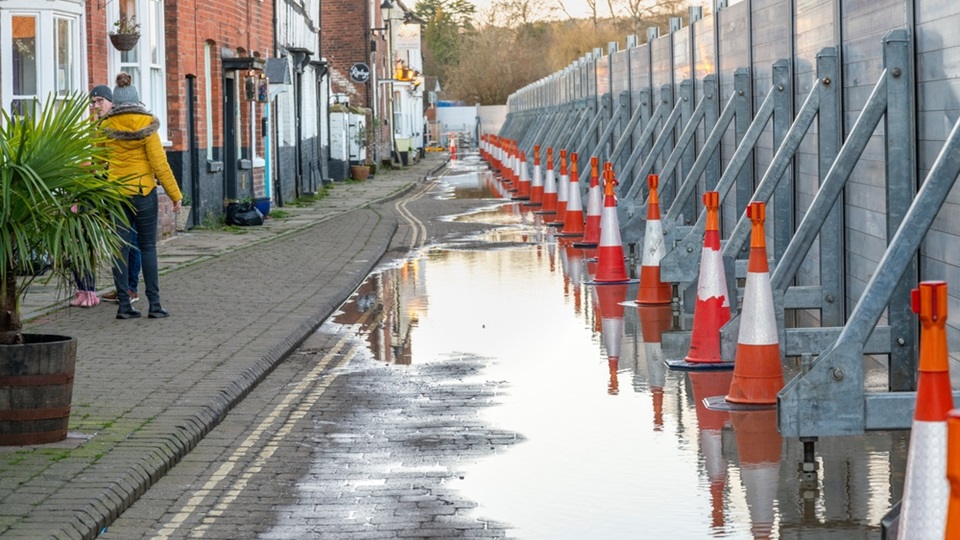
By 2069, 3.1 million properties in England will be vulnerable to river and coastal flooding if no new defences are built.
The ‘exceptionally wet’ start to 2026 emphasises the risks from a changing climate.
But despite billions in funding, the way flooding is managed across the country has been too reactive and uncoordinated.
Responsibilities are distributed across a range of bodies, including lead local flood authorities, the Environment Agency, water companies, internal drainage boards, highways authorities, and others.
The result? Inconsistent protection, slow recovery, and vulnerable communities left in the lurch.
Nationally, there's no baseline to measure how communities are adapting to this risk. There's also no mechanism for tracking progress or holding responsible bodies to account.
How could England's flood resilience improve?
The government has set out its plans to address these challenges in its response to a parliamentary inquiry and in the recent Water White Paper.
Last year, the Environmental Audit Committee – a group of MPs from across the political spectrum – held an inquiry to understand governance, investment, and regulation in flood resilience.
The government has broadly accepted the committee’s findings and recommendations.
But, the committee chair has urged ministers to act on them with greater urgency.
1. Oversight, accountability, and engagement
A clear framework is needed to improve oversight and accountability in flood risk management across the country.
The committee’s suggestions included:
- giving the Environment Agency more power;
- amending the Flood and Water Management Act 2010; or
- making a permanent coordinating body, such as the Flood Resilience Taskforce, responsible for oversight.
The government says the current National Flood and Coastal Erosion Risk Management Strategy already sets out objectives, measures and responsibilities – with the Environment Agency providing oversight.
But the agency has a legal duty to review the strategy this year.
As part of this, it will consult the Flood Resilience Taskforce on any revisions and restate the responsibilities of other risk management authorities.
Public awareness
Public engagement on flood risk is also uncoordinated.
An action group of the Floods Resilience Taskforce is developing options to improve communication and coordination with the public around flood reporting and information.
It will take the committee’s recommendation to establish a single national flood reporting and information service as ‘a starting point’.
This should offer the public a clear and accessible point of contact.
2. Using sustainable drainage systems more widely
Surface water flooding, which occurs when heavy rainfall overwhelms drainage systems, is now the most common source of flooding in England. There are 4.6 million properties at risk.
Yet it remains poorly understood, inconsistently planned for, and often underestimated in development decisions.
Implementing Schedule 3 of the Flood and Water Management Act 2010 in England would make sustainable drainage systems (SuDS) mandatory in all new developments.
SuDS are environmentally friendly techniques to help manage and control surface water runoff close to where it falls.
The government ‘recognises the importance’ of SuDS and the need to increase their uptake.
But it thinks this could happen through its ongoing planning policy reforms and by exploring other options to strengthen adoption and maintenance, rather than implementing Schedule 3.
There will be a further consultation before it decides which course to pursue.
In the meantime, without Schedule 3 to clearly assign responsibility or identify funding, the use of SuDS will remain inconsistent.
3. Embedding catchment planning
A catchment-based approach, which manages water and flooding at the scale of entire river basins or drainage areas, is widely recognised as essential for integrated water management.
The Water White Paper pledges to improve joined-up regional planning and to move to a catchment-based model.
The government is considering opportunities to align existing planning tools and groups, such as catchment partnerships.
These groups will work with the Department for Environment, Food and Rural Affairs (Defra) to co-design a new regional planning framework, to be implemented in 2027.
Funding for catchment partnerships will also double.
4. Valuing nature-based solutions
Nature-based solutions (NBS) offer one of the most cost-effective, sustainable tools for building flood resilience in England. They should be a core component of flood and coastal erosion risk management.
At least 3% of flood and coastal erosion risk management investment over the next three years, and 4% over the next 10 years, will be directed towards natural flood management projects.
Barriers that have made it difficult to prioritise nature-based options are also being removed. This includes steps to:
- prioritise projects by the overall benefits they deliver;
- remove the limit that meant projects could have no more than 20% of their outcomes as environmental benefits; and
- make funding available to a wider range of delivery partners like environmental and community groups that specialise in natural flood management projects.
5. Embedding resilience in investment
The UK lacks a coherent framework for embedding flood resilience into public investment.
Defra’s flooding budget hasn’t met the scale of the threat. Risk data, policy ambition and funding aren’t aligned.
The committee wants it to rise to at least £1.5 billion per year by 2030 to keep pace with climate impacts.
Funding will rise to £1.4 billion on average each year from 2026/27 to 2028/29.
New strategic objectives should also drive funding towards the most beneficial interventions that will be measured by defined economic, environmental and other outcomes.
Resilience standards
The government must also move faster to put in place clear, measurable resilience standards.
The Water White Paper confirms resilience standards for water assets are in development – but did not set a timeline.
The government should also build on this to embed resilience as a core test for all spending across departments and public investment proposals.
The government promises ‘an ambitious and impactful’ fourth National Adaptation Programme in 2028.
This will set objectives and delivery plans which will incorporate resilience standards ‘where appropriate’.
The ICE’s view
The ICE strongly supports the EAC’s recommendations so it’s encouraging that the government broadly accepts them.
The ICE supported the Environmental Audit Committee’s inquiry through a roundtable hosted at the ICE’s London headquarters.
We also submitted written evidence as part of the committee’s consultation process which emphasised themes like systems thinking, SuDS, and nature-based solutions.
However, while the government recognises the importance of these solutions, the challenge is in the urgency needed to deliver them.
Many of the committee’s recommendations suggest action within the next two years.
But its chair warns that many of the government’s responses are subject to future reviews, consultations, and strategy refreshes rather than ‘decisive commitments’.
The ICE will continue to push for quick and comprehensive implementation.
Originally published 16 October 2025

Sustainable Development Goals:
You may also be interested in

- Type
- Infrastructure blog
How much is climate resilience truly worth?
A new ICE report calls for a review into the value of infrastructure adaptation and climate resilience in order to boost investment.

- Type
- Infrastructure blog
Mike Reader MP: the UK's Seventh Carbon Budget is an anti-poverty measure
The transition to net zero will lower costs, create jobs, and drive growth, writes the chair of the All-Party Parliamentary Group on Infrastructure.

- Type
- Infrastructure blog
The climate threat is worsening, but a well-adapted UK is within reach, says the CCC
The UK is ill-prepared for the weather extremes it's already facing. In its latest advice to the government, the Climate Change Committee (CCC) explains why it doesn't have to stay that way.