





Joaquin Flores and Professor Sabih Khisaf share what it was like to leave their home countries as refugees and what helped them feel at home abroad.
In the aftermath of a disaster, civil engineers are among the first to help pick up the pieces.
Whether it’s rebuilding or repairing structures, or re-establishing vital transport connections and utility services, there are so many ways that engineers can help.
When some of these disasters end up displacing people from their homes, there’s another crucial thing engineers can do: support each other.
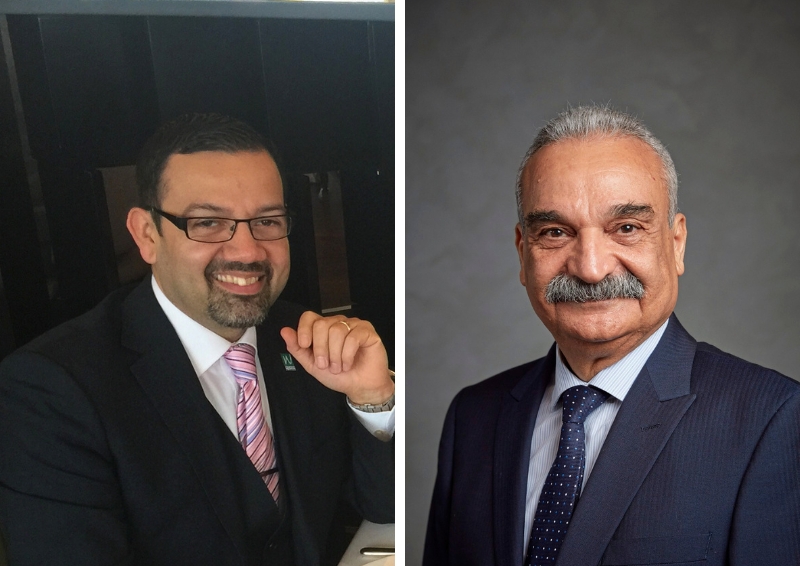
We spoke to two ICE members, Joaquin Flores and Professor Sabih Khisaf, to hear about their experiences as refugees and get their advice for anyone going through a similar situation.
The Refugee Employment Network
The Refugee Employment Network seeks to bridge the gap between refugees, employers and opportunities.
The network collectively reaches over 40,000 refugees, and in just two years has supported 550 employers, shared over 17,500 inclusive vacancies and connected 2,000 refugees to employers through job fairs.
Arriving in the UK
Joaquin, now a project director for UK&I and the Middle East at AtkinsRéalis, arrived in the UK as a refugee from El Salvador in 1980.
He fled the Salvadoran Civil War after it had claimed the lives of his father and brother. With his mother remaining to arrange family matters, it was Joaquin, his brother, cousin and grandmother that got on the plane to London.
Sabih, the infrastructure lead for the MENA region at Hyperloop Transportation Technologies, Inc, left his home country in the Middle East in 1977.
He made the decision as he'd faced coercion to join the country’s governing party, something he did not wish to do.
He arrived in Eastern Europe and threw himself into his studies, where he met his now-wife.
But at the time, his immigration status meant they weren’t allowed to get married. It took them several years to get approved.
But in 1989, they succeeded, and in 1990 they moved to the UK with an eight-month-old baby and two suitcases in tow.
The language barrier
“Not speaking English was by far the biggest barrier, as well as not having established friendships and leaving everything familiar behind,” says Joaquin.
“But as a seven-year-old, you deal with what’s put in front of you and you do the best you can.”
Joaquin’s first year in school was spent learning English, and he struggled to participate in class.
Amnesty International, the human rights charity, introduced Joaquin’s family to others that had moved to England, and they established a close-knit community.
Then, a move to a school in Enfield in London saw him find a love for mathematics and science, and he was encouraged to grow and make use of these abilities.
Discovering civil engineering
“It was a trip to Hull and driving under the Humber Bridge that started my fascination with civil engineering,” says Joaquin.
“I was baffled at how that piece of concrete in the middle of the span was able to hover over the Humber!”
He studied a master's degree in civil engineering at the University of Leeds and secured a work experience placement at Arup’s Leeds office, which then led to a job offer.
“How lucky was I!”
Understanding the industry
Sabih’s experience was different. When he arrived in the UK, he had a PhD in bridge design but still couldn’t secure employment.
“It was difficult to find a job as an engineer without holding a UK civil engineering degree,” he explains.
“The thing that surprised me was that all employers asked me if I had any knowledge of the UK's design standards and regulations. Without this, I was rejected as a candidate.”
Sabih decided to “go back to school” and studied a master’s degree in structural design at Kingston University in London.
After he completed the course, he was able to get a job as a bridge designer with a consultancy within a couple of months.
Advice for engineers arriving in a new country as refugees
“Although it's important for you to network with those from your country or culture from a wellbeing perspective, it's important to mix with others from new cultures,” says Joaquin.
This helps you to practise your new language, learn local customs and build your personal and professional network.
“If you can get someone that can guide you through what are sometimes challenging scenarios, then all the better,” he suggests.
On that point, Sabih recommends contacting local charities in your area that support refugees.
Professional institutions, such as the ICE, and trade organisations can also help.
Why you should take part in the refugee mentoring scheme
“Arriving in a new country with new customs, language and culture is very daunting,” says Joaquin.
“Navigating new processes and networks can also be a barrier to being able to progress in your chosen field or career, so choosing a mentor that is aware of the challenges you are facing is a great help.”
In recent years, Joaquin mentored a fellow engineer and helped her realise that she had enough work experience to apply for chartership through the ICE’s Experiential Learning route.
“It demonstrated to me how a little bit of guidance can unlock an individual’s hidden potential and talent for the benefit of them, their organisation and the industry as a whole,” he says.
For refugees in particular, this guidance can go a very long way.
Sabih highlights how mentoring schemes present a “powerful opportunity to make a meaningful difference in the lives of individuals who have faced extraordinary challenges”.
Mentoring isn’t just about the support you offer, but the sense of belonging, and the ability to develop empathy and learn from each other’s cultures and experiences.
Sabih says: “As a mentor, you gain a deeper appreciation for resilience and the human spirit, while helping someone build confidence, skills, and hope for a better future.”
If you’re interested in mentoring a refugee, please contact [email protected].

Sustainable Development Goals:
You may also be interested in

- Type
- News
RAEng names 4 leading ICE members as Fellows
The Royal Academy of Engineering (RAEng) has announced 75 individuals who are making outstanding contributions to the profession.

- Type
- Awards and competitions
Accessibility-first railway revamp wins at the ICE London Awards 2026
Held on 30 September 2026 at the ICE headquarters, One Great George Street, the awards recognised impactful infrastructure projects across the city.

- Type
- ICE Community blog
When every consultancy looks the same, where does innovation go?
There’s no shame in making a name for yourself in a consolidated industry, writes Steven Yule, ICE country representative for the UAE.