





From a fishery building shaped like a fish to a concert hall that looks like a piano, discover these unique mimetic structures.
Article originally published 4 July 2022
Mimetic architecture is a style of building that – as the name suggests – physically imitates the function or purpose of the structure.
Oscar Wilde said that ‘life imitates art’. But as these mimetic buildings show, sometimes it’s art that imitates life.
These unconventional designs are a celebration of the best of bold, brilliant, and innovative thought.
1. The National Fisheries Development Board, Hyderabad, India

No, you’re not seeing bubble!
Fish Building, as it’s informally known, is the headquarters of India’s fisheries department.
This four-storey, 1,920 square-metre structure resembles a giant fish, with fins, scale-like windows, and glassy blue eyes.
Located near the bustling Hyderabad airport, the building’s façade is clad with stainless steel panels.
Raised off the ground by pillars, it was designed to give the impression of a fish swimming in mid-air.
At nighttime, it’s illuminated with blue-purple spotlights, making it resemble a fish swimming through the darkest of oceans.
2. Mimetic House, County Leitrim, Ireland
Located in the village of Leitrim County in Western Ireland, Mimetic House, by architect Dominic Stevens, reflects its green surroundings. pic.twitter.com/vCYL3ZgkHg
— Arch Journal (@ArchJournal) March 17, 2017
Are you looking at an actual house or is it an optical illusion?
That might be a question you ask yourself when you first see Dominic Stevens and Brian Ward’s brainchild, Mimetic House.
Contrary to the crowding associated with urbanisation, Stevens and Ward designed Mimetic House to reflect and incorporate the natural world.
Constructed in 2007 in Dromahair, County Leitrim, Ireland, it has semi-reflective glass designed for solar control, meaning that the house mirrors the environment outside.
The areas for sleeping and working are also built into the ground, giving Mimetic House a Hobbiton-like mystical quality that could be straight out of a Lord of the Rings film!
3. Piano House, Shannan district, China
Piano and Violin House, Huainan, China pic.twitter.com/DNxOhWV7BR
— RΛMIN NΛSIBOV (@RaminNasibov) January 5, 2019
This mimetic building is dazzling in scale and construction.
Located in the Shannan district of Huainan, China, it comprises a piano-like structure with a violin leaning against it.
Designed by architectural students from Hefei University of Technology, the piano was built using black glass panels with white glass strips that serve as the windows.
The violin forms the entrance to two concert halls – and the building is also an exhibition space for development plans for the district of Shannan.
It also has a roof terrace, sheltered under a canopy shaped like a propped-open lid of a piano.
Piano House hits the right notes for the residents of the Shannan district.
It’s a popular tourist spot for newlyweds to pose in front of, leading to some calling it ‘the most romantic building in China’.
4. Kansas City Public Library, Missouri, United States

If you love books as much as we do, you’ll delight at the sight of Kansas City Public Library.
Built in 2004, the exterior of the parking garage is designed to look like a giant bookshelf.
Impressively, the whole project was a collaborative community effort, with the citizens of Kansas asked to help choose the 22 titles that would form the façade.
With classics ranging from Harper Lee’s To Kill a Mockingbird to Ralph Ellison’s Invisible Man, this eye-catching structure reflects the diversity of its books and Kansas City's people.
5. Dancing House Hotel, Prague, Czech Republic

Prague attracts tonnes of visitors each year with its stunning baroque and gothic architecture, fantastic cultural experiences, and sheer beauty. It’s also home to the incredible Dancing House Hotel.
It was constructed in the 1990s and nicknamed the Fred and Ginger, after the dancers Fred Astaire and Ginger Rodgers. The stone tower symbolised Fred and the glass tower depicted Ginger.
Built out of 99 concrete panels of varying shapes and sizes, it also has protruding window frames that give it a 3D effect.
The result is a piece of structural wizardry worthy of the dreamy surrounds of the Rašín Embankment.
6. The Big Basket, Ohio, United States
If Ohio wasn’t on your travel destination list, it should be now! Home to the Cuyahoga Valley National Park, the Great American ballpark and the oldest continuously operating light house on the Great Lakes, this state may be calling your name.
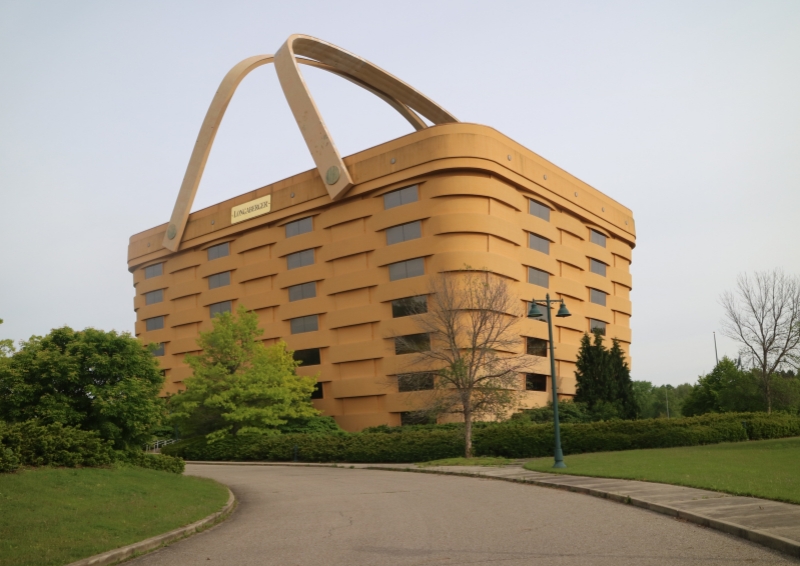
Now we’ve got another site for your visit list, the Big Basket building.
It used to be the headquarters for the Longaberger Company, a brand famous for its handwoven maple wood baskets.
It’s a seven storey, 16,723 square metre building, built to resemble a – you guessed it – woven basket. A building made to look like a basket is not easy to design and build because the top is wider than the bottom.
If it’s not unique enough, this building has another feature: heated handles.
At the top of the building is a glass roof, overlooked by two big handle-resembling structures. Due to Ohio’s cold temperatures, the handles heat up to stop ice falling onto the glass ceiling.
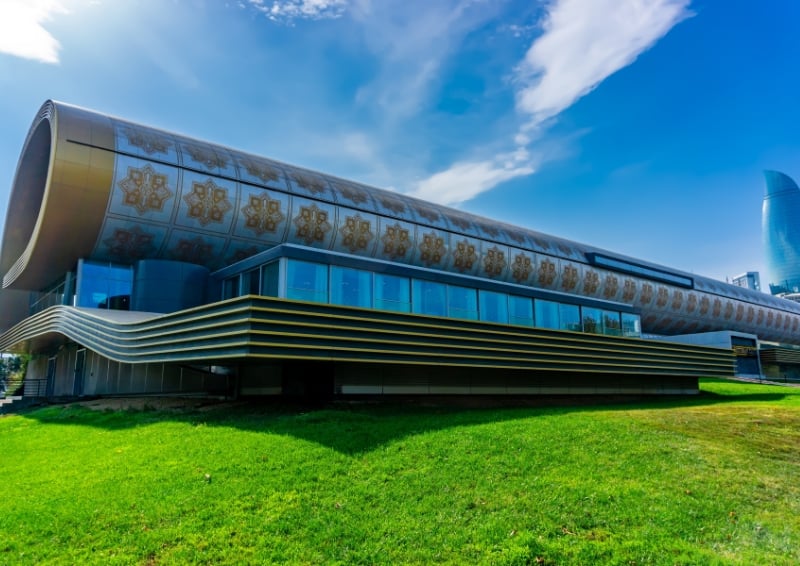
7. The Carpet Museum, Baku, Azerbaijan
We know you’re going to be floored by this one.
This museum’s history dates back almost 60 years and during this time it’s had many homes, including a 15th century mosque and the Baku Museum Center.
It’s home to the largest collection of Azerbaijani carpets in the world, and in 2010, it became part of UNESCO’s Representative List of the Intangible Cultural Heritage of Humanity.
In 2014, it got a new home, which was design to look like… a carpet!
Taking six years to build, it’s walls are curved on the inside and outside, so you can truly immerse yourself when looking at one of their 6,000 carpets.


You may also be interested in

- Type
- News
RAEng names 4 leading ICE members as Fellows
The Royal Academy of Engineering (RAEng) has announced 75 individuals who are making outstanding contributions to the profession.

- Type
- Awards and competitions
Accessibility-first railway revamp wins at the ICE London Awards 2026
Held on 30 September 2026 at the ICE headquarters, One Great George Street, the awards recognised impactful infrastructure projects across the city.

- Type
- ICE Community blog
When every consultancy looks the same, where does innovation go?
There’s no shame in making a name for yourself in a consolidated industry, writes Steven Yule, ICE country representative for the UAE.