





ICE President David Porter explains why he’s shifted away from the term ‘intelligent client’.
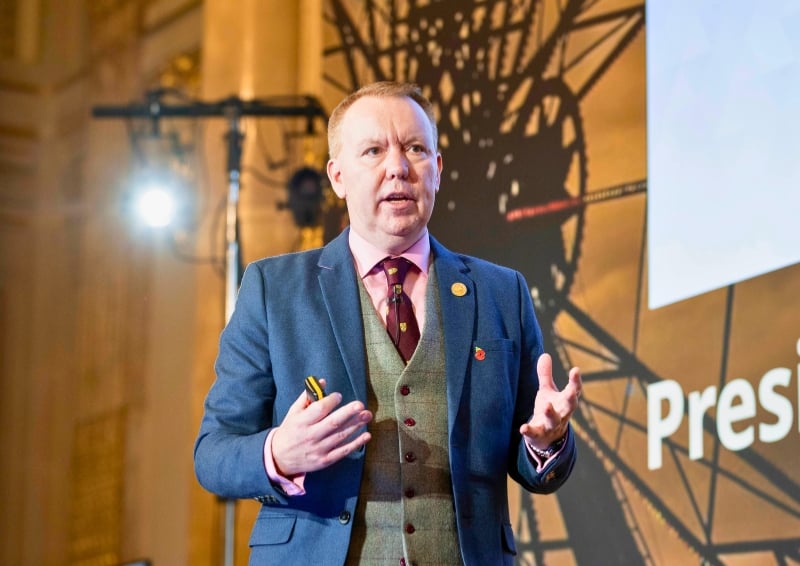
During my year as ICE president, I’ve had some great conversations about the importance of having ‘informed clients’ on projects.
You may be more familiar with the term ‘intelligent client’, but for me ‘informed client’ is a better description, and that difference in language is vital.
The intelligence of decision makers is rarely, if ever, the issue – they are generally smart, educated, well-meaning people – but being informed is a different matter.
What does it mean to be an informed client?
The client sits at the centre of infrastructure delivery, and an informed client will increase the likelihood of a project being successful.
They understand how systems work, they are clear about the consequences of decisions (and in particular, the trade-offs), and they continually develop that understanding over time.
An informed client understands the trade-offs
From my own career, particularly in flood risk management and highways, it’s become very clear that decisions about infrastructure are rarely simple.
They involve trade offs – between cost and resilience, between short term disruption and long term benefit, between environmental impact and economic growth.
An informed client recognises those trade-offs and seeks information to ensure they are equipped to weigh them properly.
An informed client thinks about outcomes, not deliverables
Informed clients understand, not only the asset being delivered, but the wider system around it.
Infrastructure is never just a piece of physical kit that sits in isolation of its surroundings. It’s an enabler of society as it supports regeneration, placemaking and economic growth, but it must do so in a way that allows people and the planet to thrive.
We need to move beyond narrow ways of assessing value. Focusing solely on benefit-cost ratios doesn’t adequately capture the wider benefits that infrastructure delivers to communities, to the environment, and to long-term resilience.
An informed client understands that broader picture and uses it to guide decision-making.
What is climate resilience truly worth?
The ICE is currently undertaking work on how to encourage more investment in adaptation by better understanding its economic value.
An informed client understands the whole lifecycle of assets
As well as building new infrastructure, we need to be thinking about maintaining and renewing these assets, as well as those we already rely on.
Infrastructure assets are under pressure due to their age, increasing demand and climate impacts – a point highlighted in this year’s State of the Nation report.
We need a long-term, strategic approach to asset management and sustained investment in maintenance and renewal to ensure that our infrastructure continues to deliver for society.
An informed client understands the need to not just focus on new build and prioritises maintenance as a year-on-year activity.
The client sets the tone for projects
One of the strongest reflections from my conversations across industry – whether in roundtables with senior leaders, site visits, or discussions with graduates – is that the client sets the tone which then percolates across the wider team.
An informed client establishes the culture of a project. They influence behaviours, shape relationships, and done right, this ultimately affects outcomes.
Get that right, and you create the conditions for success.
You often see this most clearly in how teams work together.
Shared understanding leads to better outcomes
One of the road resurfacing contracts I was involved with early in my career is a good example of collaborative working.
As the client, I needed to understand the risks and the constraints faced by the contractor.
They also needed to appreciate what was important to the client, in terms of programme delivery, quality and minimising the disruption to the travelling public while ensuring safe working conditions.
Having a shared understanding helped the contract to be managed successfully for both parties which in turn ensured that we were delivering value for money for the public.
By contrast, I can think of other projects, where that clarity isn’t there, misunderstanding follows, and with it, inefficiency and delay.
In my experience, collaboration works best when there is an informed client who genuinely understands what they are trying to achieve and why.
Developing informed clients across the sector
If we accept that informed clients are central to better outcomes, the next question is how we encourage more of them.
This starts with capability. We need people who understand our infrastructure systems, who are comfortable dealing with their complexity, and who can communicate well.
We also need to recognise that knowledge doesn’t stand still, which is why as members of the ICE we are required to focus on our continuing professional development (CPD).
Whether it’s new technology like AI, new delivery models, or new ways of assessing value – we all need to continue to learn.
Be an informed client in the transport sector
Join the first ICE Resilient Transport conference this September to develop your understanding of how we future-proof the networks we all rely on.
With over 50 presentations on offer, you'll leave with practical resilience strategies that you can start applying today.
Register todayOne of the ICE’s core responsibilities is to ensure that those working across infrastructure have the skills, knowledge and experience to take well-informed decisions.
Importantly, learning doesn’t stop when you become professionally qualified. It has to be maintained and strengthened through your career.
CPD is fundamental, and the ICE has a wide variety of resources available for members, including content to fulfil the now-mandated themes of:
- ethical and professional behaviours, including the ICE Code of Professional Conduct
- safety and risk management
- sustainable development, including decarbonisation and the application of nature-positive solutions
A change in mindset
Developing more informed clients will require a change in mindset.
We need clients who really understand infrastructure but it's not about having all the answers. It’s about being willing to listen, to engage with experts across the supply chain, and to bring people together to find the best solution.
This convening is something the institution is very well-positioned to do, so if you haven’t yet, then I would encourage you to ‘find your place in the ICE’.

Sustainable Development Goals:
You may also be interested in

- Type
- News
RAEng names 4 leading ICE members as Fellows
The Royal Academy of Engineering (RAEng) has announced 75 individuals who are making outstanding contributions to the profession.

- Type
- Awards and competitions
Accessibility-first railway revamp wins at the ICE London Awards 2026
Held on 30 September 2026 at the ICE headquarters, One Great George Street, the awards recognised impactful infrastructure projects across the city.

- Type
- ICE Community blog
When every consultancy looks the same, where does innovation go?
There’s no shame in making a name for yourself in a consolidated industry, writes Steven Yule, ICE country representative for the UAE.