

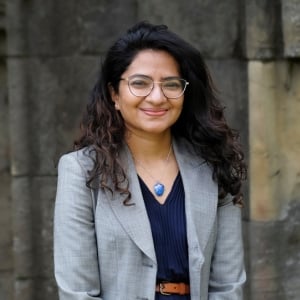
Chanchal Samuel
Expertise
GeotechnicalLocation
Yorkshire & HumberMy highlights
Progressing from graduate engineer to task leader at Jacobs early in my career
Working on the 2019-2020 Wessex landslides to protect the public
Achieving ICE Chartership and being nominated for the Renee Redfern Hunt Memorial Prize
I would recommend a career in rail because…
You get to work for the greater good.
Getting people from A to B safely, sustainably and efficiently – while applying geotechnical skills in my case – gives you a real sense of satisfaction.
A career in rail also offers the chance to work across a wide range of geographical areas, each with its own geological challenges, so you are constantly learning and evolving.
Getting people from A to B safely, sustainably and efficiently gives you a real sense of satisfaction.
What’s the most exciting part about being a rail engineer in the 21st century?
Being a rail engineer in the 21st century means working at the intersection of heritage and innovation.
We’re enhancing capacity and safety on a Victorian-era network – an engineering marvel built with limited geotechnical understanding.
Today, with advanced data, modelling, and digital tools, we design earthworks that are safer, more resilient, and increasingly aligned with climate change adaptation goals.
Compared to 200 years ago when railways were pioneering feats of industrial ambition, today’s engineers benefit from a wealth of scientific insight and technological capability.
Yet, the challenge remains just as thrilling: to build infrastructure that lasts, evolves, and serves society.
Looking 200 years ahead, I imagine rail systems will be carbon-neutral, digitally integrated, and fully automated, forming part of seamless, multi-modal transport networks.
Predicting the environmental landscape that far ahead is challenging, but the excitement lies in bridging centuries of engineering progress while shaping sustainable infrastructure for generations to come.
We asked Chanchal…
A day in your life...
Most days begin in the office, immersed in meetings that drive innovation, tackle risks, and strengthen collaboration across Network Rail.
These sessions often involve cross-disciplinary teams, suppliers, and academic partners, all working towards shared goals.
My current focus is on the strategic improvement of safety and performance in the eastern region, specifically within geotechnical engineering.
This involves analysing data, reviewing incidents, and identifying opportunities to enhance resilience and reliability across the network.
It’s a role that demands technical insight and stakeholder engagement, and no two days are ever quite the same.
What inspired you to work in civil engineering? And why did you specialise in rail?
I grew up around civil engineers and always loved the idea of turning dreams and visions into something tangible.
I used to love looking at floor plans of houses and imagining how that house may look like after construction.
I didn’t originally specialise in rail as I worked across different sectors as a geotechnical designer, but as my career progressed, I found rail the most challenging and exciting.
What’s the most exciting project in rail at the moment?
Not just one, but the wave of transformative infrastructure schemes like HS2, the TransPennine Route Upgrade, and East West Rail.
These initiatives are not only reshaping connectivity across the UK, but the insights and learnings from these programmes will hopefully influence approaches across the industry.
From a geotechnical perspective, what’s particularly exciting is the technological innovation happening behind the scenes.
We’re seeing smarter use of weather data, improved tools for earthworks modelling, and more robust approaches to asset assurance - especially in response to challenges like desiccation and slope safety.
These developments are helping us design infrastructure with lifespans of 125+ years, even on Victorian-era networks. All while actively supporting climate change adaptation by making assets more resilient to extreme weather and long-term environmental shifts.
Looking ahead, the integration of digital tools and sustainability goals will continue to push boundaries, making this a thrilling time to be part of rail engineering.
What’s the biggest thing the public misunderstands about railways and how they operate?
Many underestimate the railway’s complexity. Each journey is the result of countless coordinated decisions and expert input while managing one of the oldest railway networks in the world.
Network Rail manages 20,000 miles of track, 30,000 bridges, tunnels, and viaducts, and over 2,500 stations, making it one of the most intricate rail networks globally.
The infrastructure spans urban hubs, rural landscapes, and even coastal and geotechnical zones, requiring diverse engineering expertise.
Every train journey relies on a vast network of professionals - engineers, planners, safety experts, and many others - working behind the scenes to keep the system running safely and efficiently.
It’s not just about tracks and trains; it’s about coordination, innovation, and constant problem-solving.
What makes it especially rewarding is seeing the real-world impact of our work - whether it’s a newly opened station, improved safety measures, or enhanced passenger experience.
That sense of purpose and pride is why so many of us choose to build long-term careers in the railway industry.
What do you think is the key to a society-wide modal shift towards public transport, particularly rail?
The key is integration, accessibility, and reliability.
Seamless connections between modes, affordable fares, and real-time information make public transport more attractive.
Ultimately, modal shift isn’t just about infrastructure. It’s about changing perceptions and habits.
That requires strong policy support, public engagement, and a shared long-term vision for a greener, more connected future.
How does your role contribute to making the industry more diverse and inclusive?
I get inspired by engineers who are good at what they do, and it doesn’t matter to me what gender or what their background is.
I hope to inspire others in a similar way – by continually developing my skills and striving to be the best version of myself.
Network Rail has an employee gender equality network called Inspire.
I joined initially because I wanted to learn about other people’s experiences and build my network as everyone’s challenges are different.
Today, I’m in the committee for my region and help to organise events within the network.
I have greater appreciation of the struggles of our frontline staff that are outside my discipline due to joining this network.
What role does digital technology play in your job?
Digital plays a huge role in my day-to-day work and conversations!
A lot can be learnt if we have the right data in our hands, whether it comes from machine learning or satellite technology.
What motivated you to become professionally qualified?
Being professionally qualified with the ICE has been a milestone in my career. It validates my expertise and judgement, giving employers and peers confidence in my capabilities.
What does being professionally qualified with the ICE mean for your career?
Achieving chartership boosted my confidence. It’s a recognition of the hard work and decisions I’ve made along the way.
But it’s not the end. It opens doors to further development, leadership opportunities, and the chance to mentor others on their ICE journey.
It’s a mark of professionalism that stays with you and helps you contribute more meaningfully to the industry.
How did the ICE and your employer support you to become professionally qualified?
I’ve had so much encouragement and support from colleagues at Jacobs and Network Rail.
My line manager encouraged me to ‘be selfish’ with my time by working on my CEng application during a busy period at work.
He kept reminding me that I would only be doing this once in my career.
At Network Rail and Jacobs, my supervising civil engineers were inspirational and helped me gain confidence in my abilities.
I feel like I am surrounded by some good cheerleaders who genuinely only want the best for me!
ICE membership development officers were also crucial for my IEng and CEng applications.
How has being a member helped your career?
Having access to free CPD videos and events has helped throughout my career.
In my current role, it really helps to raise greater awareness within our teams on providing details of projects outside our immediate industry.
What’s the biggest or most complex thing you’ve made out of Lego?
Unlike many civil engineers, I didn’t have Lego as a child. But as an adult, I was so excited when I got my first set from ex-colleagues a couple of years ago.
I can’t claim to have done anything super complex yet, but I have put together a few BrickHeadz pieces (including the pair of dogs and a Storm Trooper) which each took me about an hour.
My husband recently bought one of the Lego F1 car sets, and we are both trying to agree who is going to do it first.
Do you have any hobbies?
Reading fiction and non-fiction outside of the industry helps me to be more well-rounded.
I have just finished reading the autobiography of a CEO and just started reading the science fiction novel, Project Hail Mary by Andy Weir.
I also enjoy being creative, whether that be learning to play an instrument, painting or cooking.
I’m learning the piano through a scheme at the University of York, and that’s an amazing way to unwind from work.
Even if I learn slowly, it doesn’t matter – I really enjoy it and find it meditative.
I'm enjoying discovering lot of new songs – it's a great mood lifter!
Chanchal's career path
I went to the University of Nottingham to study civil engineering.
When I graduated, it was the middle of a recession, and it took almost two years to secure a graduate position in civil engineering.
In the meantime, I worked wherever I could – in retail, as a volunteer and I also served as a technical assistant in highways.
I kept trying and applying despite the many rejections.
I was over the moon when I received the graduate job offer from Jacobs, which changed the trajectory of my life in a very positive way.