





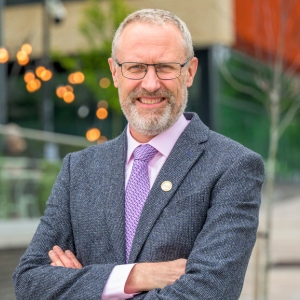
Geoff Ogden
Chief transport planning and development officer, Transport for Wales
Expertise
Design, Project ManagementLocation
WalesMy highlights
Working on the Penarth Haven landfill construction project, part of the Cardiff Bay regeneration scheme
Designing and overseeing the construction of Aberaman Phurnacite Works railway bridge strengthening from start to finish
Leading the Transport for Wales team developing the next phase of the South Wales Metro
I would recommend a career in rail because…
I think it’s important to think more broadly than just ‘rail’.
Although I have been closely involved with rail projects for the past 10 years, I really view it as part of the wider transport network.
The challenge for all engineers is to think about the whole network, and make sure each mode, be it rail, tram, bus, active travel, etc, is working in the best way it can.
I would encourage anyone in the early part of their careers to keep an open mind and learn as much as possible.
One of the brilliant things about working in civil engineering is that there will always be new opportunities and things to learn.
Hopefully communities will be at the heart of infrastructure delivery for the next 200 years and beyond.
What’s the most exciting part about being a rail engineer in the 21st century?
Some of the most interesting challenges that we face today aren’t the modes of transport themselves, but how effectively they join up.
Improving transport isn’t just about making modes of transport better, it’s thinking about how people get information, how people purchase tickets, and their end-to-end journey.
For example, if they’re walking, wheeling or cycling to the station, how easy is for them to move on to the next stage of their journey?
Thinking in this way takes you beyond the nuts-and-bolts of engineering and really gets to how improving transport will make a difference to society.
How we deliver infrastructure has really changed in the past 30 years or so. We are moving beyond infrastructure being ‘done to’ communities and working much more in partnership with them.
The role of an engineer isn’t to tell communities, ‘This is what you’re getting’, it’s to support and empower communities to get the infrastructure that best meets their needs.
Working closely with communities will hopefully be at the heart of infrastructure delivery for the next 200 years and beyond.
We asked Geoff…
A day in your life...
In a nutshell, my role is to identify transport challenges and suggest the best solutions.
My team and I work with stakeholders like local authorities to examine what transport solutions will best meet the needs of Welsh communities.
We help develop rail and active travel business cases as well as regional transport plans.
To do this, we use data to dig into what potential solutions this would require. For example, would they need new track and signalling?
Using data as part of our planning process helps us arrive at evidence-based solutions.
I work closely with my team leaders every day to understand the challenges they have – my job is to make sure they are as successful as they can be.
My team covers analytics and data, business case development, advisory services for the Welsh government, active travel scheme development and design, sustainability, and innovation.
It’s a wide range – no two days are the same.
What inspired you to work in civil engineering? And why did you specialise in rail?
When I was growing up, the gentleman who lived next door to my gran was a civil engineer. He used to lend me copies of New Civil Engineer.
The stuff I read in there is really what triggered my interest in civil engineering – that, and I always wanted to do a job where I could be outside.
What’s the most exciting project in rail at the moment?
I would say the South Wales Metro!
The Core Valley Lines Transformation project is technologically interesting in its own right, but it will make such a difference to the communities around it.
It’s a huge opportunity for investment in South Wales and will create social and economic opportunities for people who live and work locally.
It’s really exciting from an engineering point of view, but also in terms of the difference it can make, which is what civil engineering is all about.
What’s the biggest thing the public misunderstands about railways and how they operate?
I don’t think the public has misunderstood railways, I think there’s an element of railways misunderstanding the public that we have a big opportunity to correct.
The way the rail industry is set up is complicated. Track and trains are managed separately, you have regional company franchises and open access operators, different devolution arraignments throughout the UK, etc.
The public doesn’t need to understand any of that. What the public needs is a positive system that works for them.
If we can make the system simpler for the public to use, more people will use it. Our focus needs to be on making things simpler, quicker, and continuously safer.
What do you think is the key to a society-wide modal shift towards public transport, particularly rail?
Better choices for the public are really important.
Lots of people are committed to the idea of making travel choices that are better for the environment, but sometimes they’re too difficult.
We have to make it easy for people to choose public transport.
A good example of something that makes it easier is pay as you go – being able to tap your card to pay and not having to buy tickets is a barrier removed.
How does your role contribute to making the industry more diverse and inclusive?
Listening is one of the most important things I can do.
I am in a privileged position, but as a leader I prioritise building diverse and inclusive teams with lived experience of the issues we’re trying to address.
I also listen to the diverse communities we serve and the partners we work with.
What role does digital technology play in your job?
Digital technology is transforming the way we approach solving transport problems.
I have a data and analytics team that is using geospatial information systems to source insights that feed into our decision making.
We’re also developing things like virtual station tours so that people can familiarise themselves with a station before they arrive.
This is useful for all kinds of reasons. For example, it can help wheelchair users plan their journeys better.
What motivated you to become professionally qualified?
For me, chartership was an expectation of the career path I was on. I wanted to work for an engineering consultancy, so becoming chartered was essential.
What does being professionally qualified with the ICE mean for your career?
After I got chartered, I became involved with the ICE in several ways.
I was an elected regional member in Wales, I got involved with our Transport Engineering Group, then I was honorary treasurer and later chair for the Wales regional committee.
My regional experience led me to seek election to ICE Council, which I did for six years.
The biggest impact has been how much these roles and associated opportunities have helped me grow my network and understand how things like strategy development works.
It has reinforced the importance of collaboration. All these lessons have carried over into my day job.
How has achieving Fellowship changed your career?
Achieving Fellowship is something I’m very, very proud of.
I couldn’t have anticipated that back when I graduated.
When I did get it, it was massive confidence boost.
Fellowship really is a mark of credibility that makes people want to engage with you.
Do you have any hobbies?
I am quite interested in photography.
When I was chair of ICE Wales, I suggested we start a photography competition because we needed more regional imagery. It’s still running today.
I like that I was able to take a personal interest and turn it into something that met a need.
Geoff's career path
I took a fairly traditional path.
I did maths and science-based A-levels, then an accredited university degree.
Then, I did an ICE training agreement through my employer to get chartered.
I applied for Fellowship a few years later.
Major projects
South Wales Metro, part of the Wales and Borders Rail Franchise



Related Content

- Type
- Infrastructure blog
How the Wales transport strategy will deliver for communities and climate
Transport for Wales’ Geoff Ogden describes how the country’s transport strategy will facilitate a shift to healthy, sustainable travel.

- Type
- News
Nominations open for ICE president
Candidates who meet the requirements are invited to stand to represent the institution as a future president of the ICE.

- Type
- ICE Community blog
What's the foundation of flood resilience? Information
ICE President David Porter explains why being informed about flood risk is so important for the public and civil and infrastructure engineers.